So far, I've seen three of the films nominated for the Academy Award for Best Picture: "Crash", "Brokeback Mountain", and "Munich." Of these three, while not a bad picture,"Crash" is by far the weakest. It is also the film that won, of course.
My thoughts on both "Brokeback Mountain" and "Munich" are both recorded elsewhere on this blog, but I haven't written about "Crash", mainly because I felt ambivalent about it. It is too forced, contrived, and stilted to really work as a serious drama. All the characters spout racist comments not because it is what they would naturally do as characters, but because the film is about racism and the screenplay requires that they do so.
For instance, in the aftermath of a car crash that opens the film, a woman from South America accuses the Chinese woman driver of the other car of not being able to drive because she's an Oriental. The Chinese woman angrily levels a similar race-based insult at her. Would either of these women really behave this way at an accident scene, belligerently exchanging racial comments? Highly doubtful. The same contrived insincerity glares out when a black male cop (Don Cheadle) makes a comment to his Hispanic lover about her culture "parking cars on their lawns." Say what? And the film is stuffed with scenes like this that do not ring true, incidents that are glaringly false, and coincidence stretched beyond believeability.
What "Crash" does have going for it is an excellent ensemble cast, including Sandra Bullock and Brendan Fraser in roles of a type they have seldom, if ever, tackled before. But the great cast does not make up for shallow plot contrivance. I am genuinely mystified that "Crash" won the Oscar nod over well-written, interesting, artistically shot films like "Munich" and "Brokeback Mountain." But I guess I shouldn't sweat it as the trail of Best Picture winners is littered with films that are largely, and deservedly, forgotten today, while other superior films lacked even a nomination.
Still, the wide acclaim "Crash" has received is puzzling. Anyone, especially admirers of the film, have any insights?
May 11, 2006


May 3, 2006
UNITED 93
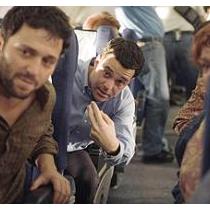 On September 11, 2001, United Airlines Flight 93 departed Newark for San Francisco with 33 passengers and seven crew members. Four of the passengers were an Al-Quaeda cell, and the plane became the fourth to be hijacked that awful day. United 93 tells what happened, in real time, aboard the plane and on the ground. It cuts between the passengers and crew aboard the plane, air traffic controllers, and military commanders, and shows the struggle to understand the unthinkable and the slow realization by the passengers that they have to band together and do something or they will become the victims of a suicide mission that will kill people on the ground as well as themselves.
Writer and director Paul Greengrass has crafted an astonishing, tense, beautifully shot, edited, and acted syncretism of fiction and documentary filmmaking. As in Greengrass’ similarly excellent Bloody Sunday, United 93 uses, brilliantly, several tactics to drop viewers in the centre of the events and ratchet up the verisimilitude.
Greengrass shoots the film using handheld cameras and grainy film stock. As in a documentary film, the cameras follow characters around and pan quickly from person to person in an attempt to take in vital conversations. Crucial dialogue and actions often happen at the edges of the frame, forcing us to strain to take in everything, exactly as if we were an observer on the ground. The film’s POV offers no Godlike omniscience; we know exactly as much as the characters know, as they know it. There are no shots in the film that could not be interpreted as the view of a human observer.
 Many of the actors are simply playing themselves in the roles that they inhabited that day. Ben Sliney, for instance, plays himself as he was, the supervisor of the National Air Traffic Control Center in Herndon, Va. The passengers are played by an ensemble of mostly unknown actors. These actors studied the lives of their real life counterparts and together with Greengrass, partially improvised the dialogue and actions aboard Flight 93. Dialogue is sharp but underwritten, frequently overlapping as in real life when events race ahead of people’s ability to take them in. All the people in the film are humanized, even the terrorists aboard the plane, so we can relate on some level to everyone.
The result of Greengrass’ ‘fictional documentary’ techniques is an utterly convincing journey into the events on the ground and aboard Flight 93. And the ultimate effect is completely harrowing. The final 30 minutes of United 93 are, without exaggeration, the tensest moments I have ever experienced in a movie. It is, quite properly, frightening and disturbing, but also essential viewing for anyone even slightly interested in exploring the events of September 11 and in studying how cinema can have a profound effect on viewers.
Though the film has no heavy political subtext, there are political messages to be found connected to United 93. According to Greengrass, “by examining this single event something much larger can be found – the shape of our world today.” The passengers and crew of flight 93 were faced with a terrible choice: sit back and hope the situation resolves, or fight back and face the potentially devastating consequences. The world has faced this dilemma since 9/11, but there has been another choice, the nature of the fight. Many have naturally assumed that ‘fight’ means violence, and the shape of the West’s response has been military. Flight 93 ended in destruction for both sides. There are other ways to fight. Greengrass has also opined that there were two hijackings that took place that day: the hijacking of the planes by terrorists, and the hijacking of Islam by religious fanaticism. U.S. actions have certainly made that latter hijacking more effective. Another point raised in the film is the complete inability of the military to receive authorization to use force against the hijacked planes and clear rules of engagement. A further discussion United 93 may raise is the appropriateness of the U.S. government’s response to the attacks.
At its core, though, United 93 is about a group of people, on the ground and in the air, who have to rapidly come to grips with the unthinkable. In its depiction of the responses of terrified, confused people to horrific circumstance, United 93 is one of the best films of its type ever made.
---
Written and Directed by Paul Greengrass
(Cast list too long to duplicate here.)
Apr 21, 2006
Ray Harryhausen: An Appreciation
 1974 was the year Ray Harryhausen took me on a Golden Voyage, and I was never the same again. Eight years old, huddled in the darkened dream hall of the Studio 1 and 2 in Newport, Wales, thrilling to the fantasy swashbuckling of Captain Sinbad, swinging his heroic blade against a homunculus, a ship’s figurehead come to life, a mystically animated six-armed statue of the goddess Kali, and a one-eyed centaur. If movies are dreaming with your eyes open, then I was ecstatic in the lucidity of a cinematic fever dream, drinking in sights and sounds piped straight from the fertile imagination of the master of such things—Ray Harryhausen.
Strictly speaking, it was not my first introduction to Ray’s work. The chronology is fuzzy in memory, but somewhere around 1973 “Jason and the Argonauts” sailed onto British TV screens and became the focal point of childhood conversation in school playgrounds. The bronze giant Talos, metal head turning to look down at Hercules, stealer of godly artifacts, was the very first of Ray’s stop-motion animation my innocent eyes feasted upon, and I was instantly hooked. These were the days before video and DVD allowed easy repeat viewings, so I drank up every precious second of the film, save the final few scenes. It was late, and my parents sent me off to bed after Jason slayed the hydra, but before the fight with the skeletons who sprang up from the ground where the hydra’s teeth were cast. And so I missed arguably the greatest of all Ray Harryhausen’s stop-motion animation sequences, and the next day had to sit mum, green with envy, as the other kids recounted this sequence in great detail, awestruck. But it didn’t matter; I drank it all up and wanted more.
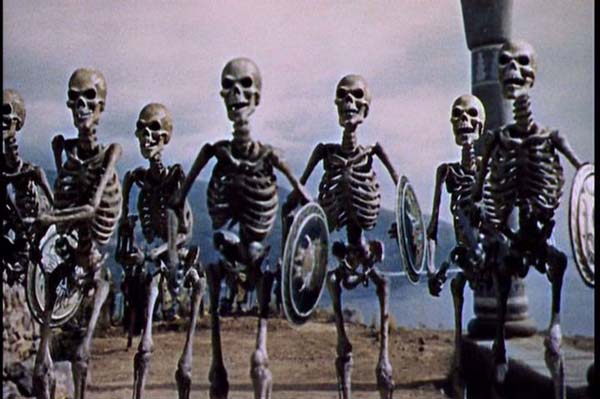 And, these being the days when Ray Harryhausen was still making movies, I got more. The next summer brought “The Golden Voyage of Sinbad” to cinema screens, the second of Ray’s films about the legendary sailor, after Kerwin Matthews battled the Cyclops and fought a duel with a skeleton in “The 7th Voyage of Sinbad” back in 1957, the first of Ray’s films in colour.
There was a really dull, grown up program on British TV that came on around lunch time. It was essentially a frothy current affairs / general interest type show that my parents had on and found myself watching idly over the remains of lunch. One day, however, the dullness dropped away momentarily as the show featured a short item on a soon-to-be released feature, Sinbad’s aforementioned Golden Voyage. My memory is hard to read on this point, like a faded film print, but I vaguely recall a film clip that featured the fabulous griffin in a prelude to its battle with the evil centaur. Eyes as wide as saucers, imagination firing wildly, I was immediately rapt with trance-like attention. And a few weeks later I was there with my dad, watching the mythic hero’s voyage unfold on the silver screen.
 The centerpiece of “The Golden Voyage of Sinbad” is the sequence where the six-armed statue of Kali, reanimated by black magic, sprouts a sword in each hand and launches into a swordfight with Sinbad and his men. Like all of Ray Harryhausen’s greatest work, it is beautifully choreographed. Consider that, for the live action, the actors had to act out the entire swordfight against nothing save a stick for their eyesight line. Then further consider that Ray designed and built the model of Kali and painstakingly animated it to match the trajectory and movements of the actors and their swords. But beyond the impressive creativity, patience, and sheer skill involved in shooting and animating the sequence, it is important to remember that Ray was involved in developing it from the very beginning, from initial idea to concept art to the actual writing. Ray Harryhausen is so much more than a visual effects master; he is an artist, period.
Ray had two more doses of monsters, myth, and magic for me to experience in the cinema. 1977 brought “Sinbad and the Eye of the Tiger”, the sailor’s final voyage, upon which I set sail with my grandmother and two cousins at the Odeon in Newport. And four years later I thrilled to the adventures of Perseus in “Clash of the Titans”, which was to be, sadly, Ray’s final film. Cinema had begun to change considerably. George Lucas’ “Star Wars” and “The Empire Strikes Back” had set the celluloid world afire, setting new standards for visual effects and box office blockbusters. Ray’s films were suddenly considered quaint by many, though ironically both of Lucas’ space fantasy epics contained stop-motion animation and the visual effects artists who worked on the films were all inspired by Ray’s work.
As a child, the book that most influenced me was “Horrors—From Screen to Scream”, Ed Naha’s encyclopedic overview of horror, fantasy, and science fiction films. The names of the people behind the films were as familiar to me as pop stars and sports heroes were to other kids--Boris Karloff; Bela Lugosi; James Whale; Jack Pierce; Willis O’Brien; Val Lewton; Peter Cushing; Terence Fisher; Robert Bloch; Richard Matheson. But one name rose above the others: Ray Harryhausen. I read Naha’s book so often that it was all but memorized, and the synopses of Harryhausen’s films lived in my head long before I actually saw the movies.
In the years after Ray’s last film, like a dedicated gumshoe I sought and watched every Harryhausen movie. In the days before videotapes became common, this meant scouring TV guides for showings. One summer, ITV ran a season of films, one every Saturday afternoon. The last film in the season was “Valley of Gwangi”, in which cowboys ventured into a lost valley and came face to face with dinosaurs courtesy of the mind and hands of Ray Harryhausen. Awaiting Gwangi, it turned out to be the longest summer of my life. But it was worth it. The main set piece of “Valley of Gwangi” is the roping of an Allosaurus by several cowboys on horseback. It remains jaw-dropping to this day.
Videotapes were a godsend, though. I finally built up a collection of Ray’s films on VHS tape, later to be replaced by DVD. The last Harryhausen film I caught up with was a laserdisc of “First Men in the Moon”. After that, it has been countless affectionate revisits of the films, including a few on the big screen at repertory theatres, and fascinating readings of Ray’s wonderful book “An Animated Life.”
In 2006, I had the privilege of talking to Ray on the phone, albeit briefly, as part of organizing a virtual appearance by him at the University of Lethbridge. Entitled “Grand Illusions: The Fantasy Worlds of Ray Harryhausen”, the event succeeded beyond my wildest dreams. Terry Gallie, from the Department of New Media at the university and a fellow Harryhausen fan, hosted the event and was similarly awestruck. Terry and I listened in on a media phone interview of Ray, beaming like happy schoolboys. Hearing Ray talk on the phone and live via videolink at the event was a precious memory, and reminded me of the continued fascination and genuine interest Ray and his work still holds.
There is a wonderful, hard-to-define alchemy to a Harryhausen film, but in essence his films port directly to the childlike wonder, awe, and comforting fear inherent within us from the moment we begin to perceive the world around us. Some bury that jeweled box of wonder; others preserve it, and it is those of us who save it that continue our love of Ray’s films into adulthood.
Though Ray Harryhausen retired from making films in 1981, his legacy of pure cinematic magic burns on, even brighter perhaps than in the heyday of his movies. What he has given to me, and millions of moviegoers around the world, is precious: the sense that the world still holds some mystery and awe; belief in the ability of heroes to overcome monsters and the gods themselves; and the understanding that the painstaking, dedicated work of creative individuals can transport us to a better place and lift our souls. Thanks for the memories, Ray; thanks for the dreams; and thanks for the wonder, the yearning of childhood for magic. We need it now more than ever.
Ray Harryhausen: A brief filmography
Mighty Joe Young (1949)
The Beast From 20,000 Fathoms (1953)
It Came From Beneath the Sea (1955)
Earth Vs. the Flying Saucers (1956)
20 Million Miles to Earth (1957)
The Seventh Voyage of Sinbad (1958)
The Three Worlds of Gulliver (1960)
Mysterious Island (1961)
Jason and the Argonauts (1963)
First Men in the Moon (1964)
One Million Years B.C. (1966)
Valley of Gwangi (1969)
The Golden Voyage of Sinbad (1974)
Sinbad and the Eye of the Tiger (1977)
Clash of the Titans (1981)
Apr 5, 2006
Match Point
 “The man who said ‘I'd rather be lucky than good’ saw deeply into life. People are often afraid to realize how much of an impact luck plays.”
At first glance, the social drama Match Point seems a new departure for prolific filmmaker Woody Allen, but it has precedence in the writer/director’s oeuvre. Its roots lie in Allen’s Crimes and Misdemeanors, specifically in the story where ophthalmologist Judah Rosenthal (Martin Landau) has a morally troubling descent into crime as he searches for a way to silence a woman with whom he’s having an affair. Match Point also has echoes of classic literary novels like Vanity Fair that involve the moral disintegration of characters as they sell their souls to ascend the ladders of society. (It also reminds me, though the context is different, of Harlan Ellison’s description of the experience of writing a TV series for an unscrupulous producer, something to the effect that you climb a vast mountain of cow shit to plant a single rose in the top, only to find that by that time you have lost your sense of smell. The essay’s called Somehow, I Don’t Think We’re in Kansas Anymore, Toto and is well worth seeking out. But I digress.)
In Allen’s Match Point, former tennis pro Chris Wilton (Jonathan Rhys Meyers) befriends Tom Hewett (Matthew Goode) while teaching tennis at a London club. Tom is of an extremely rich family, and his sister Chloe (Emily Mortimer) has eyes for Chris, and they begin a relationship as Chris is welcomed into the circle of the Hewett family and the ranks of the British upper classes. Already a bit of a distant character, Chris takes a turn to being an utter bastard when he seduces Tom’s fiancée Nola (Scarlett Johansson). The further he becomes entrenched in the upper class, the more Chris is protective of his position in society, and the greater his moral decay. The story spirals slowly downwards, with a shocking decision by Chris that reveals the iciness at the heart of his character.
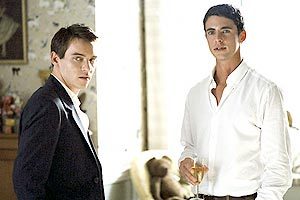 There is an inescapable coldness at the heart of Match Point, and it comes from the main character, Chris. This presents the film’s major problem. With the protagonist a distant, frosty-hearted bastard who is given little character depth and background, there is a hollowness at the centre of the film. The result is that, by the last third of the film, we no longer care about him and watch with detached interest as a couple of final twists reveal the impact of blind fate on our lives.
Having said that, Match Point is extremely well-made and acted, and has the virtue of remaining eminently watchable right up to the somewhat depressing denouement. There is an inspired shot towards the end that is a mirror image of an earlier shot, and the resolution should not be a surprise if you’ve seen Crimes and Misdemeanors.
Though flawed, Match Point is easily the best film Allen has done since 1992’s Husbands and Wives.
---
Written and Directed by Woody Allen
Starring:
Jonathan Rhys Meyers....Chris Wilton
Matthew Goode....Tom Hewett
Brian Cox....Alec Hewett
Penelope Wilton....Eleanor Hewett
Emily Mortimer....Chloe Hewett Wilton
Scarlett Johansson....Nola Rice
Ewen Bremner....Inspector Dowd
James Nesbitt....Detective Banner
Subscribe to:
Posts (Atom)