Allright, so it's not really a "Best of 2006" list, but here is my list of favourite films of the past year. 2006 saw my decreasing ability to get to films in the theatre continue. With the demands of full-time work and family, it's very, very difficult to get out to movies in the theatre (where they should be seen, of course), but the initiation of a 'movie club' based on the book club or reading group model has had some success in increasing theatrical film visits. The idea was for a group of friends to once a month go to a movie and go out after to discuss the film. The planets have aligned only once for all of us to be there, and we've missed a couple of months, but it has worked fairly well so far.
Last year also continued my renting DVDs online with Zip.ca, which has given me access to an amazingly large DVD rental library and ensures that Blockbuster never sucks any money out of my wallet again. I recommend it for all film buffs who have similar frustrations with the lousy, esurient video stores that stock 200 copies of Pirates of the Caribbean 2 and bugger all else.
Anyway, enough of my preamble blather; these are the films I saw theatrically that I liked the best in 2006, in alphabetical order (drum roll):
Casino Royale--Within mere moments of screen time, Daniel Craig owns the role of Ian Fleming's James Bond, and the 21st 007 film recaptures the literary spirit of the Bond novels to a degree unprecedented since 1969. Bold, dramatic, well-acted, and intensely exciting, Casino Royale is easily the most engaging, entertaining action thriller of the year.
The Departed--Martin Scorcese's return to Mean Streets territory crackles with energy and creativity, is low on bombast, and boasts a compelling plot and superb acting.
The Fountain--An intensely moving fantasy/fable of the search for eternal life and an intimate, time-spanning intertwining of three stories, Darren Aronofsky's film is so beautiful it feels like it was forged in the heart of a star.
Miami Vice--Michael Mann reworks the 80s cheesefest into a lean, edgy, ceruleun adult thriller that shows the dangerous world of undercover police work in convincing detail.
The Prestige--Director Christopher Nolan makes the wait for his second Batman film less painful with this glorious, literary period revenge drama and gothic meditation on the meaning of real magic.
United 93--An astonishing blend of fact/fiction filmmaking, the final moments of this film are among the tensest ever committed to film. Paul Greengrass' docudrama leaves you shaken to the core.
V for Vendetta--In an era of bland CGI action films, it is refreshing to see an overtly political action thriller that captures the zeitgeist and challenges the viewer to ponder the meaning of terrorism and political thought control.
This is the list, lacking a couple of films I thought would make it but have yet to open in this neck of the theatrical releasing backwoods (which, in Canada, means anywhere outside Toronto or Montreal). Alfonso Cuaron's Children of Men and Guillermo Del Toro's Pan's Labyrinth look amazing; hopefully 2007 brings those and many other worthy films.
Let me know your thoughts. What did you like best in 2006?
Jan 8, 2007


Dec 12, 2006
Random Thoughts on the ‘James Bond Ultimate Edition’ DVDs
So I’ve caved in and bought the first two volumes of the Ultimate Edition DVDs of the 007 films. Each volume contains a scattershot assortment of five films, seemingly chosen by some marketing exec firing rubber darts from a toy Walther PPK at a board with the Bond film titles hanging on it. None of the titles are available separately, so if you want a favourite film or two then you likely have to put up with plunking down sheckels for the odd film that is, well, kinda crap. 
So, volume 1 has some favourites (Goldfinger, The Living Daylights, The World is Not Enough), and two middling to bottom-drawer efforts (Diamonds are Forever, The Man with the Golden Gun). The scorecard for volume 2 is two favourites (Thunderball, Licence to Kill), two middling (The Spy Who Loved Me, Die Another Day), and one dreckfest (A View to a Kill -- tell me the use of the Beach Boys in the pre-credit sequence is not a travesty). So far, I’ve only seen three of the volume 1 films in their entirety and have sampled some of the rest.
For 007 fans, the sole compelling reason to pick up these sets is the complete digital restoration done on the films by Lowry Digital, who also handled the revamps of the Star Wars and Indiana Jones films. After buying Volume 1, I decided to test drive the picture restoration through a viewing of one of the older films, Goldfinger. And, man oh man, a beautiful sight it is too. The picture quality is far beyond anything I’ve seen on home video before; it is a gorgeous transfer to disc, excelling even the laserdisc incarnation that was previously the gold standard for this film. The film almost looks like it was shot yesterday. Stellar work.
Beyond the sterling picture quality, Goldfinger is an interesting viewing experience. Frequently cited as THE best in the series (which for my money is From Russia With Love), it is indeed a slick, fast, highly-engaging piece of entertainment, and the film that cemented James Bond’s position in pop culture. Sean Connery easily commands the film with smooth assurance, and the film contains many moments that have since become classic cinema. Who can forget the laser beam sequence and Goldfinger’s line “No, Mr. Bond, I expect you to die!” Plus there’s Q’s (Desmond Lewelyn) witty retort to Bond’s “Ejector seat, you’re joking!”: “I never joke about my work 007.” But what’s interesting is how the seeds of the jokiness that were to drag the series into the doldrums are planted here.
Bond wearing a wetsuit with a duck attached to the head is a funny gag but, come on, why the hell would a soggy fake duck on a wetsuit cap be even deemed to be necessary as a stealth device? The cartoon mobsters make their first appearance in a Bond film, jokey hoods that bear all the realism of Halloween costumes (the phoney baloney gangsters reappear, sadly, in Diamonds Are Forever). And it is only the most strong-willed amongst us that can successfully suppress giggles at the hundreds of soldiers dropping on cue to the ground as Pussy Galore’s flying circus belch out stun gas over Fort Knox. There are other moments that foreshadow the James Bond Comedies of the ’70s.
The person most to blame for this is director Guy Hamilton. Look at the interviews with Hamilton on the second disc. He clearly has no interest in making any of the film remotely plausible. Thankfully the comedic zing is reined in somewhat by a good screenplay that bears at least a passing resemblance to the Ian Fleming novel. When Hamilton didn’t have some Fleming in the mix to leaven the silly humour we got: Diamonds Are Forever, Live and Let Die, and The Man With the Golden Gun. Disco Bond.
Which takes me to Connery’s last appearance in the official Bond series, Diamonds Are Forever. In spite of being overweight and sporting a bad toupee and, in one of the most genuinely scary moments in the entire 007 film series, a hideous pink tie, Connery still delivers as Bond. But the tone of the film is way off, veering into silly comedy too often, and continuing the grand You Only Live Twice tradition of jettisoning the entire novel. Though the novel is one of the weaker books, the opening credit “…in Ian Fleming’s Diamonds Are Forever” is a bald-faced lie. This is screenwriter Tom Manciewicz and director Guy Hamilton’s Diamonds Are Forever, and it is a fluffy comedy-thriller. Using this film as evidence, Roger Moore takes too much heat for turning the series to light comedy. Here’s where it really started in earnest.
(Spoilers in this paragraph.) Though it does contain some effective moments, including a grand close-quarters fight in an elevator, Diamonds Are Forever commits the cardinal sin of squandering one of the great dramatic events in the 007 series, the tragic death of Bond’s wife Tracey from the previous On Her Majesty’s Secret Service. It’s barely even acknowledged in the campy pre-credits sequence and is quickly dropped from the rest of the film. Unforgivable.
For a dramatic breath of fresh air, here comes Timothy Dalton in The Living Daylights. Though the film shows evidence of having been written for Roger Moore, with only scattered moments drafted specifically for Dalton, The Living Daylights steers back towards genuine danger and excitement in a much-needed course correction after the dire comedy-Bond of A View to a Kill. Dalton’s Bond was someone living on the edge, one step away from the psychiatrist’s couch or the morgue perhaps, and more of a flesh-and-blood character rather than a cardstock one. The plot refreshingly uses some Fleming in the opening moments, from the short story of the same name, before heading off into new material about a phony Soviet defector involved in a massive arms deal. The villains are weak and the plot a bit stale, but Dalton’s commanding, textured performance makes The Living Daylights one of the better films in the series. The picture quality on the Ultimate Edition disc is once again outstanding and the burned-in subtitles are restored, after being MIA for the previous Special Edition disc.
More random Ultimate Edition thoughts later.

So, volume 1 has some favourites (Goldfinger, The Living Daylights, The World is Not Enough), and two middling to bottom-drawer efforts (Diamonds are Forever, The Man with the Golden Gun). The scorecard for volume 2 is two favourites (Thunderball, Licence to Kill), two middling (The Spy Who Loved Me, Die Another Day), and one dreckfest (A View to a Kill -- tell me the use of the Beach Boys in the pre-credit sequence is not a travesty). So far, I’ve only seen three of the volume 1 films in their entirety and have sampled some of the rest.
For 007 fans, the sole compelling reason to pick up these sets is the complete digital restoration done on the films by Lowry Digital, who also handled the revamps of the Star Wars and Indiana Jones films. After buying Volume 1, I decided to test drive the picture restoration through a viewing of one of the older films, Goldfinger. And, man oh man, a beautiful sight it is too. The picture quality is far beyond anything I’ve seen on home video before; it is a gorgeous transfer to disc, excelling even the laserdisc incarnation that was previously the gold standard for this film. The film almost looks like it was shot yesterday. Stellar work.
Beyond the sterling picture quality, Goldfinger is an interesting viewing experience. Frequently cited as THE best in the series (which for my money is From Russia With Love), it is indeed a slick, fast, highly-engaging piece of entertainment, and the film that cemented James Bond’s position in pop culture. Sean Connery easily commands the film with smooth assurance, and the film contains many moments that have since become classic cinema. Who can forget the laser beam sequence and Goldfinger’s line “No, Mr. Bond, I expect you to die!” Plus there’s Q’s (Desmond Lewelyn) witty retort to Bond’s “Ejector seat, you’re joking!”: “I never joke about my work 007.” But what’s interesting is how the seeds of the jokiness that were to drag the series into the doldrums are planted here.
Bond wearing a wetsuit with a duck attached to the head is a funny gag but, come on, why the hell would a soggy fake duck on a wetsuit cap be even deemed to be necessary as a stealth device? The cartoon mobsters make their first appearance in a Bond film, jokey hoods that bear all the realism of Halloween costumes (the phoney baloney gangsters reappear, sadly, in Diamonds Are Forever). And it is only the most strong-willed amongst us that can successfully suppress giggles at the hundreds of soldiers dropping on cue to the ground as Pussy Galore’s flying circus belch out stun gas over Fort Knox. There are other moments that foreshadow the James Bond Comedies of the ’70s.
The person most to blame for this is director Guy Hamilton. Look at the interviews with Hamilton on the second disc. He clearly has no interest in making any of the film remotely plausible. Thankfully the comedic zing is reined in somewhat by a good screenplay that bears at least a passing resemblance to the Ian Fleming novel. When Hamilton didn’t have some Fleming in the mix to leaven the silly humour we got: Diamonds Are Forever, Live and Let Die, and The Man With the Golden Gun. Disco Bond.
Which takes me to Connery’s last appearance in the official Bond series, Diamonds Are Forever. In spite of being overweight and sporting a bad toupee and, in one of the most genuinely scary moments in the entire 007 film series, a hideous pink tie, Connery still delivers as Bond. But the tone of the film is way off, veering into silly comedy too often, and continuing the grand You Only Live Twice tradition of jettisoning the entire novel. Though the novel is one of the weaker books, the opening credit “…in Ian Fleming’s Diamonds Are Forever” is a bald-faced lie. This is screenwriter Tom Manciewicz and director Guy Hamilton’s Diamonds Are Forever, and it is a fluffy comedy-thriller. Using this film as evidence, Roger Moore takes too much heat for turning the series to light comedy. Here’s where it really started in earnest.
(Spoilers in this paragraph.) Though it does contain some effective moments, including a grand close-quarters fight in an elevator, Diamonds Are Forever commits the cardinal sin of squandering one of the great dramatic events in the 007 series, the tragic death of Bond’s wife Tracey from the previous On Her Majesty’s Secret Service. It’s barely even acknowledged in the campy pre-credits sequence and is quickly dropped from the rest of the film. Unforgivable.
For a dramatic breath of fresh air, here comes Timothy Dalton in The Living Daylights. Though the film shows evidence of having been written for Roger Moore, with only scattered moments drafted specifically for Dalton, The Living Daylights steers back towards genuine danger and excitement in a much-needed course correction after the dire comedy-Bond of A View to a Kill. Dalton’s Bond was someone living on the edge, one step away from the psychiatrist’s couch or the morgue perhaps, and more of a flesh-and-blood character rather than a cardstock one. The plot refreshingly uses some Fleming in the opening moments, from the short story of the same name, before heading off into new material about a phony Soviet defector involved in a massive arms deal. The villains are weak and the plot a bit stale, but Dalton’s commanding, textured performance makes The Living Daylights one of the better films in the series. The picture quality on the Ultimate Edition disc is once again outstanding and the burned-in subtitles are restored, after being MIA for the previous Special Edition disc.
More random Ultimate Edition thoughts later.
Dec 6, 2006
The Fountain
Death. The desire for immortality, to conquer death. Death is a disease, and I will find the cure. The Tree of Life, the key to immortality?
 Izzi is dying. Cancer. Her book, The Fountain, lies unfinished, a twelfth chapter unwritten. It is time for Tommy, her husband, to read it. In the story, Queen Isabel of Spain sends conquistador Tomas to find the tree that is said to grant eternal life.
The twelfth chapter will be written among the stars, in the heart of the Xibalba Nebula, itself the name of the Mayan underworld, the Place of Phantoms ruled by the gods of death.
“Goodbye, Izzi.”
 Rebirth. The explosion of the human into the infinite, the joining of the mortal soul with the cosmos, the infinite cycle of death and renewal.
Love is in the infinite.
“Death is the road to awe.”
The Fountain
Directed by Darren Aronofsky
Written by Darren Aronofsky, based on a story by Darren Aronofsky and Ari Handel
Starring:
Hugh Jackman....Tomas/Tommy/Tom Creo
Rachel Weisz....Isabel/Izzi Creo
Ellen Burstyn....Dr. Lillian Guzetti
Mark Margolis....Father Avila
Stephen McHattie....Grand Inquisitor Silecio
Fernando Hernandez....Lord of Xibalba
 Izzi is dying. Cancer. Her book, The Fountain, lies unfinished, a twelfth chapter unwritten. It is time for Tommy, her husband, to read it. In the story, Queen Isabel of Spain sends conquistador Tomas to find the tree that is said to grant eternal life.
The twelfth chapter will be written among the stars, in the heart of the Xibalba Nebula, itself the name of the Mayan underworld, the Place of Phantoms ruled by the gods of death.
“Goodbye, Izzi.”
 Rebirth. The explosion of the human into the infinite, the joining of the mortal soul with the cosmos, the infinite cycle of death and renewal.
Love is in the infinite.
“Death is the road to awe.”
The Fountain
Directed by Darren Aronofsky
Written by Darren Aronofsky, based on a story by Darren Aronofsky and Ari Handel
Starring:
Hugh Jackman....Tomas/Tommy/Tom Creo
Rachel Weisz....Isabel/Izzi Creo
Ellen Burstyn....Dr. Lillian Guzetti
Mark Margolis....Father Avila
Stephen McHattie....Grand Inquisitor Silecio
Fernando Hernandez....Lord of Xibalba
Dec 1, 2006
Hammer's Cornish Horrors
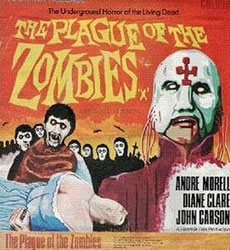 The winter months seem to lend themselves to classic horror films, to me at least, and I recently pulled out two gems from an unpacked box of videotapes. Produced in 1966 by England’s legendary Hammer Films, The Plague of the Zombies and The Reptile are period horrors set in Cornwall, a particularly beautiful part of southwest England, though both films were actually shot at Bray Studios near Windsor.
Shot back-to-back by director John Gilling using the same sets, the films were originally intended for release as a double feature but were never shown that way, as the similarity in the settings was too obvious. The Plague of the Zombies ended up on a double feature with Dracula, Prince of Darkness, while The Reptile played with Rasputin, the Mad Monk (both ‘A’ pictures starred Christopher Lee and also used similar sets). In those days, they knew how to market films. Both double bills lured audiences in with free gifts – ‘zombie eyes’ or a fake Rasputin beard – in addition to offering two films for one price.
The Plague of the Zombies was the last major zombie film before George A. Romero turned the genre on its head in 1968 with Night of the Living Dead, a film that forever associated zombies with cannibalism and led to extremely gory Italian schlock-horror. A classicly-structured mystery story, Plague tells of medical doctor Sir James Forbes (André Morell), accompanied by his daughter Sylvia (Diane Clare), investigating a series of mysterious deaths in a small Cornish village at the request of former student Dr. Peter Tompson (Brook Williams). The trail involves death, voodoo, and the living dead, and leads to callous aristocrat Squire Hamilton (played with delicious menace by John Carson).
Plague is a nifty, atmospheric little chiller with an interesting subtext of class division. The Squire and his men are portrayed as rich, arrogant upper-class thugs with little concern for the lower classes and no use for them except as mindless fodder for labour. The story unfolds as a classical, almost Holmesian mystery, punctuated by several notable horrific sequences. One involves Dr. Tompson’s wife, elegantly played by Jacqueline Pearce, rising from the dead in the village’s spooky graveyard. Another, more celebrated sequence is a green-tinted dream where the earthed denizens of the entire graveyard push their way up through the mouldering ground and lumber towards their victim. The image of a reanimated corpse pushing its way up through the soil is one that has been subsequently pinched by many horror flicks, including the atrociously gory Italian Romero rip-off, Zombie.
With atmospheric camera work and settings, nicely-textured performances, and imaginative makeup, The Plague of the Zombies is one of the most enduring creations from the Studio that Dripped Blood.
 A 19th-century mystery story atmosphere also pervades The Reptile, which is narratively similar to Bram Stoker’s The Lair of the White Worm. Harry Spalding (Ray Barrett) and his wife Valerie (Jennifer Daniel) move to the cottage they inherited from Harry’s brother, who died mysteriously in an eerie scene at the beginning of the film, skin blackened and mouth frothing from some lethal venom delivered by a bite from a man-sized something. The solution to the mystery lies buried within the local mansion, home of Dr. Franklyn (Noel Willman) and his beautiful daughter Anna (Jacqueline Pearce, once again), both of whom have run afoul of a strange occult sect from the orient.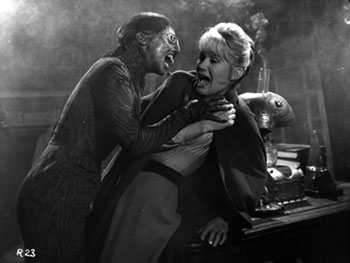
Roy Ashton’s elegant makeup on the title creature borders on iconic horror cinema, and is sympathetically portrayed like all great movie monsters. Well-shot by John Gilling and professionally acted, The Reptile is a great little horror yarn, assuming one can forget the trappings of 21st century digital cinema and enjoy inventive low-budget filmmaking.
Both films are available on DVD and VHS.
Subscribe to:
Posts (Atom)