I've moved this blog over to Wordpress, so if you're interested, and I just know there's scads of adoring fans out there, head to: http://www.imagewordsound.wordpress.com
Hope to see you there. Yes, you, I'm talking to you. The regular reader in the corner.
Jan 6, 2010


May 4, 2009
 I haven't seen the vampire phenomenon masquerading as film Twilight--its in my online rental queue more out of some sort of pop culture obligation than anything else--but I seriously doubt that it can be as beautiful, sublime, and just plain excellent as the Swedish vampire film Let the Right One In. It's a wonderful cinematic vision and a unique spin on an ancient genre. The core of the film is the relationship between a boy and his strange new neighbour, a slight 12-year old who has lived for eons, protected by a human familiar, stalking victims to slake her blood thirst.
The winter setting is effectively used in all its cold bleakness, and the two leads engage us immediately. There are some sequences that are as visually impressive as anything in the past ten years, including a finale shot from under the water of a swimming pool that rivals early Spielberg in the perfection of its execution. Director Tomas Alfredson is clearly someone to watch, and this poetic and scary film is worth seeking out before the American remake descends.
Nov 26, 2008
I don't usually do memes, but I saw this one on another blog, where you name a favourite film for every letter of the alphabet. Here goes.
A - AliensB - Black Sunday (Mario Bava, not the one with Robert Shaw)
C - Cat People (Val Lewton's)
D - The Duellists
E - Evil Dead
F - From Russia With Love
G - Gallipoli
H - Horror of Dracula
I - Incredible Shrinking Man
J - Jason and the Argonauts
K - King Kong (1933)
L - The Long Good Friday
M - Manhunter
N - Night of the Demon
O - Out of the Past
P - Pan's Labyrinth
Q - Quest for Fire
R - The Reptile
S - Suspiria
T - Treasure of the Sierra Madre
U - Unforgiven
V - V for Vendetta
W - Wild Strawberries
X - X2
Y - The Year of Living Dangerously
Z - Zodiac
ONCE
 Allow me to briefly recommend the wonderful indie music-infused romance Once. Starring Glen Hansard, now of Irish band The Frames and previously the ginger-haired guitarist in Alan Parker's great The Commitments, and real-life musical collaborator Marketa Irglova, it's a simple film about a hoover repairman and part-time musician who meets a pretty Czech immigrant on the streets of an Irish city.
What happens next I won't spoil, but it's far better done than most of its genre, and while not a musical, key scenes and emotions are conveyed through song. The soundtrack is outstanding, and one of the tunes, Falling Slowly, amazingly won an Academy Award for Best Song. I say amazingly not because it doesn't deserve it (it does), but because it was astounding that anyone who voted in the Academy had even heard of this great little film. Once is an inspiring, feel-good film without an ounce of forced emotion or overwrought Hollywood-sized sentimentality, and is utterly convincing in the emotional detailing of its characters. It's available on DVD and I strongly suggest you seek it out and buy the soundtrack.
Highly, highly recommended.
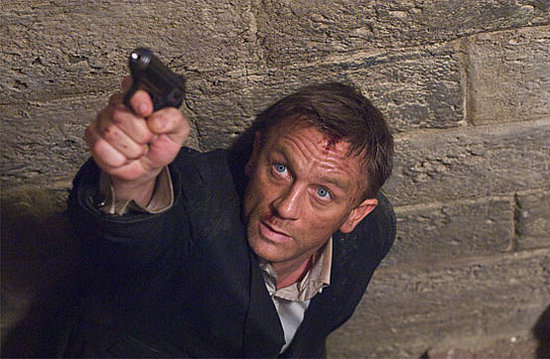
Quantum of Solace
“You’re not married, but I think it’s the same with all relationships between a man and a woman. They can survive anything so long as some kind of basic humanity exists between the two people…Incurable disease, blindness, disaster—all these can be overcome. But never the death of common humanity in one of the partners. I’ve thought about this and I’ve invented a rather high-sounding title for this basic factor in human relations. I have called it the Law of the Quantum of Solace.”
--Ian Fleming, “Quantum of Solace” (in “For Your Eyes Only”)
Through the chaos of action and fury, Bond’s true mission in this film is to find his ‘measure of comfort’, to confirm if what Vesper, who apparently betrayed Bond and committed suicide in the previous film, and Bond felt for each other was real. As in the books, if it is real, then Bond will truly understand the normal life that is cruelly denied him and will be fully equipped to protect it against the forces that conspire to destroy it.
At the start of Quantum of Solace Bond is filled with rage and pain as he coldly, methodically tracks down the organization represented by Mr. White (Jesper Christensen, also from Casino Royale), to find the answers behind the double cross of Vesper, the woman he loved. As the trail leads to Dominic Greene (Mathieu Amalric), and the tenticular tips of a mysterious international criminal organization are revealed, Bond gradually begins to fight for something beyond the personal, while still on the track of his ‘measure of comfort’ and helping another damaged soul, Camille (Olga Kurylenko) find her own. By the end of the film, the personal mission is accomplished, but the bigger one of rooting out the Quantum organization has just begun.
This subtextual emotional throughline and how it deftly combines with a Bondian mission is by far the most intriguing and successful part of Quantum of Sloace, especially in how it dovetails with Casino Royale. A Bond film that could not exist without its predecessor is a first in the 007 series, and the iconoclasm is welcome, accompanied as it is by a comfortingly retro feel to the set decoration and photography.
Unfortunately the producers hired second unit director Dan Bradley to film most of the action sequences. Bradley is one of the foremost practitioners of the shaky cam/quick cut school of action, where disorienting chaotic dissonance substitutes for the geographical clarity and elegance of classic, old school action filmmaking. This technique has its place, I suppose, but its dominance in modern action films is disconcerting and its placement in a Bond film is decidedly unwelcome. The opening car chase, for instance, has a certain adrenaline kick, but it’s almost impossible to tell what vehicle is doing what to whom, which is exactly the point according to Bradley, whose philosophy is that the viewer should not get more than fast, fragmented views of the chaos onscreen. Bradley is welcome to his philosophy, but as far as I’m concerned the practitioners of the shaky cam/quick cut school can shove it. Bring back clarity to action cinema, I say.
That quibble aside (plus a minor plea to bring back title designer Daniel Kleinman for the next one), Quantum of Solace is a fast, stylish, engrossing, superbly-acted bookend to Casino Royale and a tantalizing look forward to the future of the Bond series. Daniel Craig once again owns this role, and he’s matched by the brilliant Judi Dench as M, and a strong ensemble supporting cast.
---
“…I should say you’re absolutely right. Quantum of Solace—the amount of comfort. Yes, I suppose you could say that all love and friendship is based in the end on that. Human beings are very insecure. When the other person not only makes you feel insecure but actually seems to want to destroy you, it’s obviously the end. The Quantum of Solace stands at zero.”
--Ian Fleming, “Quantum of Solace” (in “For Your Eyes Only”)
Feb 26, 2008
No Country for Old Men
Written and Directed by Joel Coen and Ethan Coen
Based on the novel by Cormac McCarthy
Starring: Josh Brolin, Tommy Lee Jones, Javier Bardem, Woody Harrelson, Kelly Macdonald, Tess Harper
 Even the low-key opening shots of a desolate Texas landscape, shot with cinematographer Roger Deakins' pellucid camera, announce that No Country for Old Men is a startling return to form for the brothers Coen. Working this time from the stark, weary poetry of the Cormac McCarthy novel, the Coens have constructed a near-perfect meditation on the violence of our times and the inability of 'good' people to ride out to meet it.
The core narrative tells the story of Vietnam vet Llewelyn Moss (Josh Brolin, in his second great performance from 2007 after his supporting role in American Gangster), who stumbles upon the aftermath of a drug deal gone bad, the only thing remaining being corpses, one lone survivor barely alive, enough shell casings to be melted down into a stealth bomber, a shitload of drugs, and a breathtaking wad of cash. Moss, of course, takes the dough, which unleashes a fan-hitting storm of Babylonian proportions and triggers a relentless pursuit of Moss by humanoid psycho-killer Anton Chigurh (Javier Bardem). Meanwhile, Sheriff Bell (Tommy Lee Jones) follows the trail of clues and corpses to try and find Moss before Chigurh gets a chance to do what he does best.
 Though the film would appear to be about Moss, the twin poles of this story are Bell and Chigurh. In an Oscar-winning performance, Javier Bardem portrays Chigurh as an almost extraterrestrial, uncontrollable, incomprehensible and unstoppable force of bloodshed and evil. The character's odd hairstyle, unplaceable accent, unfamiliar destructive weapons (a cattle killing device powered by compressed air and a shotgun outfitted with a cylindrical metal silencer), and automaton-like persistence build a presence that is like an alien inhabiting human skin. Chigurh is almost reminiscent of Jeff Bridges alien-in-a-cloned-body in John Carpenter's Starman, not quite at home in his bones, unfamiliar with social rituals, and uncomfortable with the phraseology of language ("Call it, friend-o."). He is a chilling representation of mindless, omnipresent, relentless evil.
In opposition is Sheriff Bell, played with weather-rasped aplomb by Tommy Lee Jones. Bell is an honest lawman, eroded by years of confronting the worst in human nature, who now ponders the fruitlessness of thinking we can ever defeat it. His reflections on the rising incidence of extreme, senseless violence and the efforts to combat it like trying to shout back the coming tide, form the reflective core of the film: “…I don't want to push my chips forward and go out and meet something I don't understand. You can say it's my job to fight it, but I don't know what it is anymore. More than that, I don't want to know. A man would have to put his soul at hazard. He would have to say, ‘O.K., I'll be part of this world.’”
 While the film is contemplative, the Coens deliver several astonishingly constructed set pieces. One sequence, involving Moss and Chigurh at a motel, waiting patiently for each to make his move, trying to outwit the other, is so brilliant in its clear construction and ability to wring gut-punching suspense out of simple image, editing, and sound, that it makes me weep for all the over-edited mash-ups of pixels and noise that I've had to endure at the cinema in the past few years. Another similarly impressive confrontation at a hotel that ends in a street chase and shoot-out is one of the most bravura slices of pure cinematic genius of any film in the past several years. The Coens take Hitchcock's ability to build unbearable suspense with rudimentary tools and apply their own darkly comic spin to amazing effect.
No Country for Old Men won the Academy Award for the Best Picture of 2007 and, amazingly enough, could actually be plausibly called the best film of 2007. It's a timeless film and a must-see.
Based on the novel by Cormac McCarthy
Starring: Josh Brolin, Tommy Lee Jones, Javier Bardem, Woody Harrelson, Kelly Macdonald, Tess Harper
Even the low-key opening shots of a desolate Texas landscape, shot with cinematographer Roger Deakins' pellucid camera, announce that No Country for Old Men is a startling return to form for the brothers Coen. Working this time from the stark, weary poetry of the Cormac McCarthy novel, the Coens have constructed a near-perfect meditation on the violence of our times and the inability of 'good' people to ride out to meet it.The core narrative tells the story of Vietnam vet Llewelyn Moss (Josh Brolin, in his second great performance from 2007 after his supporting role in American Gangster), who stumbles upon the aftermath of a drug deal gone bad, the only thing remaining being corpses, one lone survivor barely alive, enough shell casings to be melted down into a stealth bomber, a shitload of drugs, and a breathtaking wad of cash. Moss, of course, takes the dough, which unleashes a fan-hitting storm of Babylonian proportions and triggers a relentless pursuit of Moss by humanoid psycho-killer Anton Chigurh (Javier Bardem). Meanwhile, Sheriff Bell (Tommy Lee Jones) follows the trail of clues and corpses to try and find Moss before Chigurh gets a chance to do what he does best.
Though the film would appear to be about Moss, the twin poles of this story are Bell and Chigurh. In an Oscar-winning performance, Javier Bardem portrays Chigurh as an almost extraterrestrial, uncontrollable, incomprehensible and unstoppable force of bloodshed and evil. The character's odd hairstyle, unplaceable accent, unfamiliar destructive weapons (a cattle killing device powered by compressed air and a shotgun outfitted with a cylindrical metal silencer), and automaton-like persistence build a presence that is like an alien inhabiting human skin. Chigurh is almost reminiscent of Jeff Bridges alien-in-a-cloned-body in John Carpenter's Starman, not quite at home in his bones, unfamiliar with social rituals, and uncomfortable with the phraseology of language ("Call it, friend-o."). He is a chilling representation of mindless, omnipresent, relentless evil.In opposition is Sheriff Bell, played with weather-rasped aplomb by Tommy Lee Jones. Bell is an honest lawman, eroded by years of confronting the worst in human nature, who now ponders the fruitlessness of thinking we can ever defeat it. His reflections on the rising incidence of extreme, senseless violence and the efforts to combat it like trying to shout back the coming tide, form the reflective core of the film: “…I don't want to push my chips forward and go out and meet something I don't understand. You can say it's my job to fight it, but I don't know what it is anymore. More than that, I don't want to know. A man would have to put his soul at hazard. He would have to say, ‘O.K., I'll be part of this world.’”
While the film is contemplative, the Coens deliver several astonishingly constructed set pieces. One sequence, involving Moss and Chigurh at a motel, waiting patiently for each to make his move, trying to outwit the other, is so brilliant in its clear construction and ability to wring gut-punching suspense out of simple image, editing, and sound, that it makes me weep for all the over-edited mash-ups of pixels and noise that I've had to endure at the cinema in the past few years. Another similarly impressive confrontation at a hotel that ends in a street chase and shoot-out is one of the most bravura slices of pure cinematic genius of any film in the past several years. The Coens take Hitchcock's ability to build unbearable suspense with rudimentary tools and apply their own darkly comic spin to amazing effect.No Country for Old Men won the Academy Award for the Best Picture of 2007 and, amazingly enough, could actually be plausibly called the best film of 2007. It's a timeless film and a must-see.
Jan 16, 2008
He Lives Now Only in our Memories: THE ROAD WARRIOR (1982)
 OK, let's see if I can write the opening narration of The Road Warrior entirely from memory:
"My life fades. The vision deepens. All that remains are memories. I remember a time of chaos, broken dreams, this wasted land. But most of all I remember the road warrior, the man we call Max. To understand who he was you have to go back to another time, when the world was powered by the black fuel and the deserts sprouted great cities of pipe and steel.
Gone now. Swept away. For reasons long forgotten two mighty warrior tribes went to war and touched off a blaze that engulfed them all. Without fuel they were nothing, their great machines sputtered and stopped. Their leaders talked and talked and talked, but nothing could stem the avalanche. Men began to feed on men. A whirlwind of looting; a firestorm of fear.
On the roads it was a white line nightmare; only those mobile enough to scavenge, brutal enough to pillage would survive. And in this maelstrom of decay ordinary men were battered and smashed. Men like Max; the warrior Max. In the roar of an engine he lost everything. He became a shell of a man, a burnt out, desolate man, a man haunted by the demons of his past, a man who wandered out into the wasteland.
And it was there, in this blighted place, he learned to live again..."
That was solely from memory, and it's accurate as far as I know. I quoted this opening passage for two reasons. First, to prove that I love The Road Warrior as one of my very favourite films. And second, to show how damned elegant the film is and how it elevates the story of Max from a weird cult action film (1980's Mad Max) into a grand postapocalyptic myth.
 The beginning of George Miller's The Road Warrior (known outside North America as simply Mad Max 2) is easily one of the most interesting and engaging introductions to any genre film. The narration quoted above is read over a collage of stock footage of human atrocity and various shots from Mad Max to set the stage, to orient the viewer to the world they are about to enter. At the end of the last line (...in this blighted place, he learned to live again...") the screen fades to black and the gut-punching dinosaurian roar of an engine fills the soundtrack, and the camera pulls out of the engine intake of Max's V8 Interceptor and pans across to reveal Max at the wheel, now in glorious scope widescreen (as opposed to the titles and opening stock footage in the standard academy 1.33:1 ratio).
Miller has dropped us straight into the furious, violent world of Max's postapocalyptic wasteland, all that remains of humanity following the global collapse of civilization after some unnamed disaster. The third film in the series, Mad Max Beyond Thunderdome, identifies the apocalypse as a nuclear war, but in The Road Warrior we are left to come to our own conclusions -- in our current age it could easily be the end of oil and global warming. The setting is universal enough to always appear to be part of the zeitgeist. What happened is besides the point of course; Miller's film is not a message movie, it is simply concerned with telling a thunderingly kinetic narrative on a canvas of classical myth.
 And the opening sequence following the prologue is, naturally, a car chase, with Max (Mel Gibson, in a magnetic lead performance) eluding several punks from the 'Humongous' gang of roaming wasteland scavengers. And this ain't no CGI. This is the capricious, torturous scream of metal on metal, real stunt drivers doing genuine stunts, a showcase for the immersive texture that authentic stuntwork brings to a film, something far more adrenalizing than pixellated substitutes vectorized together by a team of computer nerds could ever hope to be. As the first sequence demonstrates, The Road Warrior is one of the all-time great vehicular stunt films.
A great example of lean cinematic narrative, too, is this opening. With no dialogue and a simple directorial style, Miller shows us that Max is completely alone, that he exists solely to find gasoline to continue driving the wastelands, that he is a force to be reckoned with, and that his car is his lifeline. It also sets up a plot point for later in the film. Like I said, economic.
Speaking of economic, it's not until about 10 minutes or so in that we get the first line of dialogue, cult Australian actor Bruce Spence (who later turned up in The Matrix Revolutions and The Return of the King extended version) as the Gyrocaptain hopping rodent like on the scalding hot desert sand, thinking he's got the drop on Max. The tables are soon turned, of course, and the Gyrocaptain drives the story proper into gear by introducing Max to a remote oil refinery that is guarded by a ragtag group of survivors lead by the strong-willed Papagello against the Humongous, led by the Lord Humongous and his henchman Wez (who Max encountered in the opening), desperate to possess the precious juice.
 The Road Warrior unfolds as an action film version of the classic, enduring lone hero myth, whereby a wandering hero reluctantly aids his fellow humans and in so doing causes the rebirth of a part of his world. With very few lines of dialogue, Gibson builds a magnetic screen character, carrying Max from the bleak ending of the first film, driving aimlessly after slaughtering the killers of his family, into the logical place he would be in this film. As the opening says, "a burnt out, desolate man."
That a seemingly unsympathetic, unfeeling character becomes an attractive screen hero is a testament to Gibson's performance, the spare but effective writing, and Miller's careful direction. The story takes Max on a journey, forcing him into helping the survivors escape the Humongous and the wasteland and, however reluctantly, transforming him into the saviour of this lone band. Even if we haven't seen the first film (and I hadn't when I first saw this second installment), we get the sense that Max is scarred and hurting inside, that his seeming indifference to fellow humans is a defence against ever having someone precious taken away again. And so a laconic, mean bastard like Max becomes a sympathetic hero that we root for. It really is extraordinary how The Road Warrior pulls this off.
The film is elevated considerably by a unique and memorable cast of supporting characters. Vernon Wells creates one of the great screen villains in Wez, formidably built, growling in a low monotone, mohawked, and outfitted like all the outlaw gang in post-punk uniform scavenged from the "corpse of the old republic." The Lord Humongous, leader of the gang, is a hockey-masked gladiator with a build like Schwartzenegger. The Gyrocaptain is the film's sole comic relief, a jumpy, quirky character who takes an incredible amount of punishment from Max and still bounces back wanting to be his partner. Then there's the Feral Kid (Emil Minty), a wild child who survives in the wasteland by hunting with a razor-sharp boomerang, and who views Max as a father figure. The community in the refinery has several notable characters, including the mechanic that seems to spend his time hanging in a sling from a mini-crane and his slightly dizzy assistant; a war-helmeted, eccentric old man; a gorgeous amazonian warrior woman (who, confounding cinematic cliche and our expectations, does not become Max's new love interest); and Papagello, the strong-willed, articulate leader.
 The Road Warrior builds steadily, deliberately to its astounding final setpiece -- a 20-minute chase sequence with Max at the helm of a huge tanker containing the prized gasoline, pursued by the outlaw gang, with Wez at the head, aching for blood. It's one of the great sustained action sequences, a thunderous, unrelenting crunch of car stunts and violence, ingeniously and imaginatively staged, sharply and coherently edited, and brought to life with exhilarating stuntwork. It ends the film with cathartic, satisfying bombast.
And the coda of the film cements Max as a mythic hero, the terrific final shot a pullback from Max while the narrator intones "And the road warrior? That was the last we ever saw of him. He lives now only in my memories." As a bookend it works effectively to give a sense that this is a story that has been told to us as Homer told the story of Odysseus, and that it is a tale that will be repeated through the generations.
The Road Warrior scales heights that few action films do. The recent Blu-Ray release of the film is stunning in its clarity. Small details are now visible, such as a vein pulsing on the head of the Lord Humongous, and the whole movie has a more film-like appearance. It's a significant upgrade to the old laserdisc version I own, and is highly recommended to fans of the film. Curiously, the title of the film on this print is Mad Max 2, and it appears to have a few seconds of additional gore, so perhaps this is an international version that was cut in North America.
The Road Warrior stands easily among my top ten favourite films.
Off Topic: "Can the rest of us have our planet back?"
This is totally off the topic of movies, but I think it's hilarious. This is comedian Marcus Brigstocke on BBC Radio 4:
Jan 14, 2008
Gone Baby Gone
 Directed by Ben Affleck
Written by Ben Affleck and Aaron Stockard, based on the novel by Dennis Lehane
Starring Casey Affleck, Michelle Monaghan, Morgan Freeman, Ed Harris, John Ashton, Amy Ryan
Actor Ben Affleck makes an impressive directorial debut in the engrossing dramatic thriller Gone Baby Gone. Though shot in a simple, no-frills style, the film layers on moral complexity until the protagonist is forced to make an agonizing decision that could affect a life forever and has to live with the nagging uncertainty that his choice was wrong.
Patrick Kenzie (Casey Affleck) and Angie Gennaro (Michello Monaghan), partners in a private investigation business and also lovers, are asked to help the Boston police in searching for a missing four year old girl by the kid's aunt Bea McCready (Amy Madigan). The little girl's mother Helene McCready (Amy Ryan) is the starting point in Kenzie and Gennaro's investigation, and is revealed to be far different than the press' portrait of her as a saintly grieving mother. Young and somewhat naive, Kenzie connects with some of the people he knows from growing up on the streets of Boston, and quickly finds that Helene's drug and alcohol abuse may be key factors in the disappearance.
 Captain Jack Doyle (Morgan Freeman) leads the special police unit that handles kidnappings, Doyle himself the victim of the kidnapping of his child that went fatally wrong. Doyle orders his two lead investigating officers, Bressant (Ed Harris) and Poole (John Ashton) to cooperate with Kenzie and Gennaro, the two PIs quickly proving able to make connections on the street that are closed to the cops.
 But everything is not as it seems. Gone Baby Gone winds its serpentine way through a complex story that finds that the moral certainties we hold are shot through with so many veins of grey that making the right choice is not only near impossible, it is almost undesirable. The story argues that even righteous, just choices are usually made for the wrong reasons. In such a moral minefield, Kenzie can only hope to survive, and he is ultimately helpless in the soul-eroding tides that buffet him.
Director Affleck and photographer John Toll (who also lensed Terrence Malick's phenomenal The Thin Red Line) capture the streets and the people of Boston with convincing, personal immediacy. A sequence involving a raid on a dingy house, which turns into a nightmarish headlong flight and a confrontation with pure human evil, is particularly nail-biting, accomplished with a lean and spare shooting and editing style. On the strength of this film, Ben Affleck has a successful career as a director ahead of him.
The dialogue crackles, and it is delivered by a superb cast, with Ed Harris in particular at the top of his game. Casey Affleck shines as the main protagonist, projecting a core naivete that is dragged through the ringer as he is forced to confront some agonizing choices. Harris and Affleck share a scene that sparks with vitality and drama -- and it is all acting and dialogue. It all leads up inevitably to a final agonizing choice, and a final shot that is searingly effective in its simple ability to provoke discussion over the viability of that choice.
Gone Baby Gone is a smart, involving slice of neo-noir.
Jan 8, 2008
2007: Films of the Year
Yeah, it's another one of those lists that pop up and parthenogenetically propogate through various publications at the beginning of every year. What were the best films of last year, or more accurately, here's what moved me at the cinema in 2007. While such exercises may get tedious to some, a best of list affords a time for reflection on the medium of film and gives cause to hope that in the midst of the drool-cup mass consumption pablum there are great examples of pure cinema out there and still getting made and distributed.
My 2007 list contains some films that were distributed in late 2006 in limited release but didn't make it to cinema screens here until 2007, but such is the sad state of film distribution -- if you don't live in one of the handful of key big cities for movie releases, then you're likely screwed.
Thank goodness for DVDs. And now Blu-Ray discs (I'm a recent convert).
Anyway, here's the cinematic highlights of 2007 for me.
Pan's Labyrinth -- Fantastic film auteur Guillermo Del Toro's utterly captivating, profoundly moving, richly symbolic, and immersively imaginative dark fantasy has quickly become one of my very favourite movies. It's one of the crowning achievements of fantasy cinema, a work of such heartbreaking and layered artistry that it can stand with the great works in any artistic medium. Someone let this guy loose on his adaptation of Lovecraft's At the Mountains of Madness NOW.
 Children of Men -- A truly great work of science fiction, based on P.D. James' novel, that creates a chilling and utterly believable future world where women have stopped giving birth and the human race is slowly dying, populates it with interesting characters, and pulls us along in a propulsive and thrilling storyline. Director Alfonso Cuaron brings several vivid sequences to life, including an astonishing one-take action scene that is one of the best recent examples of pure cinema.
Zodiac -- David Fincher's absorbing and beautifully filmed police procedural about the obsessive hunt for the Zodiac killer in '60s/'70s era San Francisco is an instant classic and can easily stand with the enduring examples of its genre from 1970s American cinema. Though the film sadly tanked at the box office, I'm tempted to say that, Pan's Labyrinth aside, Zodiac was the best film I saw at the theatre in 2007.
 Eastern Promises -- Singular filmmaker David Cronenberg brings his stark, disturbing but humanistic vision to a crime story set among the Russian mafia in London. Actor Viggo Mortensen reunites with Cronenberg after the superb A History of Violence and the result is an interesting departure for the cerebral director. It doesn't quite escape it's rather ordinary narrative origins, but is elevated by Cronenberg's direction and some vivacious performances, and contains one of the great hand-to-hand fight sequences.
American Gangster -- Master stylist Ridley Scott is in such control of recreating time and place that you can almost reach out and touch the cinematic textures. In such surroundings Russell Crowe and Denzel Washington shine in another retro-'70s crime thriller that thankfully leaves aside thundering action for story and character. Crowe is a rare combination of star and actor.
 The Mist -- Stephen King's spine-tingling novella about an ominous mist that descends from Lovecraftian dimensions dragging vicious beasties with it and traps a group of townsfolk in a supermarket is finally brought to the screen by master King adapter Frank Darabont. Thomas Jane and Marcia Gay Harden head up an effective cast and the story is as much about the disintegration of civilized discourse and the seduction of religious fanaticism as it is about horrific monsters. And the sucker-punch of an ending, with its Twilight Zoneish dark irony, is unforgettable.
Sunshine -- Perhaps not a great film, but certainly an outstanding one whose vivid imagery has stayed with me. It is rare for modern SF cinema to consist of anything other than action films, but Sunshine has the tenacity to be about ideas and visual poetry and dramatic tension.
Unfortunately No Country for Old Men vanished from theatres here so quickly that I missed my chance to see it, and P.T. Anderson's There Will Be Blood has yet to open. I predict that these two films will appear on my best of 2008 list.
2008 brings some potentially great films: Bond 22, The Dark Knight, Indiana Jones and the Kingdom of the Crystal Skull, Del Toro's Hellboy II: The Golden Army, Pixar's Wall-E, and Iron Man. Let's hope that some of these at least live up to expectation.
My 2007 list contains some films that were distributed in late 2006 in limited release but didn't make it to cinema screens here until 2007, but such is the sad state of film distribution -- if you don't live in one of the handful of key big cities for movie releases, then you're likely screwed.
Thank goodness for DVDs. And now Blu-Ray discs (I'm a recent convert).
Anyway, here's the cinematic highlights of 2007 for me.
Pan's Labyrinth -- Fantastic film auteur Guillermo Del Toro's utterly captivating, profoundly moving, richly symbolic, and immersively imaginative dark fantasy has quickly become one of my very favourite movies. It's one of the crowning achievements of fantasy cinema, a work of such heartbreaking and layered artistry that it can stand with the great works in any artistic medium. Someone let this guy loose on his adaptation of Lovecraft's At the Mountains of Madness NOW.
Children of Men -- A truly great work of science fiction, based on P.D. James' novel, that creates a chilling and utterly believable future world where women have stopped giving birth and the human race is slowly dying, populates it with interesting characters, and pulls us along in a propulsive and thrilling storyline. Director Alfonso Cuaron brings several vivid sequences to life, including an astonishing one-take action scene that is one of the best recent examples of pure cinema.Zodiac -- David Fincher's absorbing and beautifully filmed police procedural about the obsessive hunt for the Zodiac killer in '60s/'70s era San Francisco is an instant classic and can easily stand with the enduring examples of its genre from 1970s American cinema. Though the film sadly tanked at the box office, I'm tempted to say that, Pan's Labyrinth aside, Zodiac was the best film I saw at the theatre in 2007.
Eastern Promises -- Singular filmmaker David Cronenberg brings his stark, disturbing but humanistic vision to a crime story set among the Russian mafia in London. Actor Viggo Mortensen reunites with Cronenberg after the superb A History of Violence and the result is an interesting departure for the cerebral director. It doesn't quite escape it's rather ordinary narrative origins, but is elevated by Cronenberg's direction and some vivacious performances, and contains one of the great hand-to-hand fight sequences.American Gangster -- Master stylist Ridley Scott is in such control of recreating time and place that you can almost reach out and touch the cinematic textures. In such surroundings Russell Crowe and Denzel Washington shine in another retro-'70s crime thriller that thankfully leaves aside thundering action for story and character. Crowe is a rare combination of star and actor.
The Mist -- Stephen King's spine-tingling novella about an ominous mist that descends from Lovecraftian dimensions dragging vicious beasties with it and traps a group of townsfolk in a supermarket is finally brought to the screen by master King adapter Frank Darabont. Thomas Jane and Marcia Gay Harden head up an effective cast and the story is as much about the disintegration of civilized discourse and the seduction of religious fanaticism as it is about horrific monsters. And the sucker-punch of an ending, with its Twilight Zoneish dark irony, is unforgettable.Sunshine -- Perhaps not a great film, but certainly an outstanding one whose vivid imagery has stayed with me. It is rare for modern SF cinema to consist of anything other than action films, but Sunshine has the tenacity to be about ideas and visual poetry and dramatic tension.
Unfortunately No Country for Old Men vanished from theatres here so quickly that I missed my chance to see it, and P.T. Anderson's There Will Be Blood has yet to open. I predict that these two films will appear on my best of 2008 list.
2008 brings some potentially great films: Bond 22, The Dark Knight, Indiana Jones and the Kingdom of the Crystal Skull, Del Toro's Hellboy II: The Golden Army, Pixar's Wall-E, and Iron Man. Let's hope that some of these at least live up to expectation.
Nov 20, 2007
American Gangster
 American Gangster is a strong crime drama and, like Fincher's Zodiac, is a throwback to '70s thrillers, with the absence of digital frills and cellphones and other ubiquitous modern technology surprisingly refreshing. Also like Zodiac (which, by the way, is so far the best film of 2007, in my humble opinion), the period setting is naturalistic, never calling attention to itself. But there's a great frisson in watching cops cruise dingy streets in beat-up '70s cars, smoking like chimneys, draped in leather jackets, jeans, and wide-lapeled shirts. It's like we're back in the heyday of Hollywood thrillers, and you almost expect Gene Hackman as Popeye Doyle to stride around the corner (the case that inspired Friedkin's The French Connection is even name-checked a few times).
So the setting and the look of the film are authentic to the period, and after all creating a world is something that director Ridley Scott excels at, and he masters the details of American Gangster, which suprisingly doesn't have that stylish cinematic sheen that his best work has. The photography, in fact, is rather drab, but this is clearly an artistic choice and it's one that works. Scott sells the setting, imbruing the film with grimy moral corruption, we as an audience are there, and the film then lives and dies on the strength of the story and the acting.

Thankfully American Gangster has one of the most talented casts of any Scott film. The two leads, Denzel Washington as titular gangster Frank Lucas and Russell Crowe as Detective Richie Roberts, deliver thoroughly engaging and textured performances. Crowe in particular demonstrates that he's one of the few major film stars around today that carries within him the soul of some of the great stars of the past who were, like Bogart, a synchretism of character actor and magnetic screen icon. Detective Roberts is an interesting character, totally against the usual type we see as cops in big movies. He's strong, honest and capable, but also low-key, uncomfortable and almost awkward around other cops.
Washington is his match, but he has the more cliched role, a bodyguard to Harlem crime kingpin Bumpy Johnson who ascends the criminal hierarchy after his boss dies, by smuggling high-quality, low-price heroin into the U.S. directly from the supplier in Thailand. Lucas is played a little against type, though -- he's low-key, professional, smart, and under control.
 The plot makes the point that, by cutting out the middle-man and offering a superior product at a lower price, what Lucas was doing in the illegal drug trade merely mirrored what capitalism was doing in major department stores. The script, written by Steven Zaillian based on a magazine article about the real-life Lucas, ingeniously keeps the story of the gangster and the cop entirely separate for most of the film, and finally brings the two characters together in a way that is unexpected (i.e., not in a bloody shootout or car chase). American Gangster is packed with detail and incident, and even at about 2 1/2 hours is never boring, even though it lacks any big action sequences other than a tense shoot-out.
There's a strong supporting cast that includes Armand Assante, John Ortiz (Carlito's nephew from DePalma's Carlito's Way), Jon Polito (the gangster from the Coen Brothers' Millers Crossing), Cuba Gooding Jr. (partly redeeming himself for a string of subpar roles), and John Sayles' regular Joe Morton. The standout in a supporting role is Josh Brolin as a corrupt scumbag cop, oozing slime and mendacious reptilian menace.
While it doesn't ascend the heights of greatness achieved by the classics in the crime genre, American Gangster is solid, well-acted, and engaging.
---
Directed by Ridley Scott
Written by Steven Zaillian
Denzel Washington...Frank Lucas
Russell Crowe ...Richie Roberts
Chiwetel Ejiofor...Huey Lucas
Josh Brolin...Detective Trupo
Lymari Nadal...Eva
Ted Levine...Lou Toback
Nov 6, 2007
Keane
 English actor Damien Lewis gives an astonishing performance in independent filmaker Lodge Kerrigan's mesmerizing Keane. Lewis is William Keane, a psychologically damaged man torn apart by the disappearance of his daughter, who obsessively haunts the area around a bus station in New York City, where his daughter was taken. Keane stalks the streets, ticking out staccato mutterings to himself, barraging strangers with questions about his missing little girl, but is the trauma at the centre of his shattered mind real or a product of mental illness?
 Lewis is in every frame of the film, shot by Kerrigan using a hand held camera in continuous four-minute takes and edited in-camera. Kerrigan keeps the camera tightly focused on Lewis, often framing shots with Lewis in close-up to one side of the frame, like the camera is perched on the actor's shoulder, forcing us into Keane's world with an intimacy infrequently seen in modern cinema. Keane’s gritty, realistic aesthetic achieves what the trendy shaky-cam style reaches for but usually misses: raw, honest immediacy.
I usually try to avoid hyperbole, but it's no exaggeration to say that Lewis' acting in Keane is among the most brilliant I have seen in a film: a staggeringly detailed portrayal of a complex, confused, sad, angry, fragmented soul. One of the most memorable scenes has Keane drunk in a dingy bar, shouting out the words to I Can't Help Myself, trying to drown out the images and the sheer pain in his head. In one simple but searing moment, Kerrigan and Lewis draw you into the agony of the character in an uncommonly tactile way.
 The post-9/11 zeitgeist seeps into the film through the fearful paranoia and disorientation of the main character and of the cityscapes he inhabits. Keane meets another lost soul, a woman with a little girl, who she ends up entrusting Keane with for an extended period of time during which the movie tightens the screws as it becomes unclear if Keane will protect the kid or disintegrate.
Brilliantly filmed and constructed, Keane is elevated to the upper cinematic echelons by one of the most vivacious and involving performances in cinema.
---
Written and Directed by Lodge Kerrigan
Starring:
Damian Lewis...William Keane
Abigail Breslin...Kira Bedik
Amy Ryan...Lynn Bedik
Starring:
Damian Lewis...William Keane
Abigail Breslin...Kira Bedik
Amy Ryan...Lynn Bedik
Oct 2, 2007
S U N S H I N E
 Sunshine is a visually stunning piece of science-fiction, convincingly dramatized and bursting with the majesty and belittling terror of the cosmos. Cillian Murphy plays Robert Capa, the physicist among the crew of Icarus II on a mission to deliver the ultimate bomb into the Sun, which is inexplicably dying.
 The first sections of the film deal with the discovery that the first ship sent on this mission--Icarus, which disappeared--is still in orbit around the sun and a series of mind-bendingly difficult dilemmas the crew faces when they decide to rendezvous with the first ship to obtain its unused payload. Needless to say, things do not go well, and decisions are difficult and fraught with brutal consequences that must be weighed against the future of humanity, which hangs on the success of this mission.
This part of Sunsine is absolutely riveting, drawing together philosophical threads on the worship of the Sun as an entity and the humbling vastness of space and cosmic indifference, and mixing these introspective subtleties into an absorbing tech-space drama. The interplay of the characters is convincing, the design of the sets and technology utterly realistic, with the result that the focus is on the human drama rather than whiz-bang effects. Murphy leads a stellar cast, with even Chis Evans redeeming himself for the dreadful Fantastic Four movies.
 Director Danny Boyle brings some beautifully filmed sequences to life, with the highlight being a nail-biting space walk as two of the crew attempt to manually lower two malfunctioning shield panels, garbed in thick, confining protective sunsuits. Boyle shows us the claustrophobic view of the astronauts, peering out through a narrow helmet slit, movements severely limited, perched precariously on the outside of the ship, less than mere motes in the eye of the galaxy. Writer Alex Garland layers on conflict and tension, pushing the characters in extraordinary circumstances, and requiring them to make critical sacrifices and ethical choices. How they react and what happens as a result is carefully built into the fabric of the story. A SF film that is a philosophical drama instead of an over-the-top action film is both a rarity and a breath of fresh air.
The film switches gears for its last third, in a manner that I will not describe. The change of direction is unexpected, but if you run with it, the concluding sections of the film are satisfying. If the end of Sunshine lacks the philosopical and dramatic edge of the earlier passages, it makes up for it with horrific suspense.
Sunshine is a frequently stunning and emotionally and viscerally exciting vision.
---
Directed by Danny Boyle
Written by Alex Garland
Starring:
Cliff Curtis...Dr. Searle
Chipo Chung...Voice of Icarus
Cillian Murphy...Robert Capa
Michelle Yeoh...Corazon
Hiroyuki Sanada...Capt. Kaneda
Rose Byrne...Cassie
Benedict Wong...Trey
Chris Evans...Mace
Troy Garity...Harvey
Mark Strong...Capt. Pinbacker
Chipo Chung...Voice of Icarus
Cillian Murphy...Robert Capa
Michelle Yeoh...Corazon
Hiroyuki Sanada...Capt. Kaneda
Rose Byrne...Cassie
Benedict Wong...Trey
Chris Evans...Mace
Troy Garity...Harvey
Mark Strong...Capt. Pinbacker
Sep 17, 2007
Amicus' Tales from the Crypt
 In the 1960s, Amicus Films emerged as a challenger to Hammer Films in the production of low-budget but profitable English horror pictures. Whereas Hammer are known for their vivid Technicolour gothics, Amicus' trademark was the horror anthology film, which featured four to five short shockers held together by a wraparound story that usually involved the protagonists of the various stories being doomed in some fashion. Amicus' first anthology, Dr. Terror's House of Horrors (1965) was a hit, and the studio followed with multi-story chillers Torture Garden (1967) and The House that Dripped Blood (1970), both of which were scripted by famed author Robert Bloch, writer of the original Psycho novel that Hitchcock immortalized on the big screen. In 1972, for their fourth anthology movie, Amicus producers Max J. Rosenberg and Milton Subotsky turned to the American horror comics published by William Gaines and EC Comics for inspiration and the result was Tales from the Crypt, scripted by Subotsky from stories in the titular comic and Vault of Horror (itself destined to be the title of another Amicus anthology pic).
A gruesomely fun affair, Tales from the Crypt involves five people strangely drawn to a ruined crypt becoming seperated from a guided tour and stumbling upon a secret chamber presided over by the Crypt Keeper (deadpan ham Ralph Richardson), who tells them their fate, visualized as short stories within the narrative. The best of the lot, Poetic Justice, stars genre great Peter Cushing as Arthur Grimsdyke, a lonely widower adored by children, who is persecuted by snobbish neighbour James Elliott (Robin Phillips) because he feels the old man lowers the tone of the neighbourhood, the heartless smear campaign reaching its nadir with a bundle of insulting Valentine's cards that Grimsdyke fears were written by the villagers but were in fact the work of Elliott, a cold-hearted bastard like all EC Comic villains. This being a horror picture, Grimsdyke returns from the grave to exact Hallmark-inspired revenge upon his callous neighbour, who gets his just desserts in the same way as all the other selfish assholes do in this film and in the weirdly moralistic universe of Gaines' horror comics.
 Cushing expertly and effortlessley garners our sympathy, sitting by himself to supper while talking to a portrait of his dead wife, a photograph that is actually of Cushing's beloved wife Helen, who died prior to the production of the film. Cushing adored his wife, and if you read his autobiography Past Forgetting, the actor reveals that he contemplated suicide after her death, so deep was his grief at her passing. The inclusion of her photograph in the film undoubtedly helped Cushing in his performance, and adds a deeper layer of melancholy for those who know the subtext. Grimsdyke's awful dismantaling by heartless Elliott is beautifully captured by Cushing, proving once more that the actor was worth his weight in gold to any horror film, as director Freddie Francis has noted. It's a wonderful performance, one for which Peter Cushing was awarded The Licorne d’Or Award for Best Actor at the 2nd French Convention of Fantasy Cinema, and it elevates the Poetic Justice segment to heights the other stories can't quite reach.
 That's not to say there's not lots of fun to be gained from the other segments. In All through the House, for instance, Joanne Clayton (Joan Collins) murders her husband on Christmas Eve, while her little girl sleeps upstairs waiting for Santa, while a psychopath dressed in a Father Christmas outfit pays her house a visit. It's fun to watch Collins portray the kind of bitch she became famous for, this time in a low-budget horror film. The best of the rest is the last story, where another genre vet, Patrick Magee, stars as a blind person who leads his fellow sightless inmates of a home for the blind in taking sadistic revenge against the heartless new head of the institution. In all of the stories, the awful bastards responsible for awful deeds receive a comeuppance that is an order of magnitude worse than those they perpetrated in the first place. A gruesome collection of horror stories is an odd place to get such a conservative message, but here it is, in all its 'eye for an eye' glory.
Famed cinematographer Freddie Francis directs with a colourful if undistinguished sense of style. Francis got his start in helming several films for Hammer, but achieved his real fame as an outstanding director of photography for movies like Glory, The Elephant Man, and The Innocents. His directing career was less stellar, being confined mostly to low-budget British horror films, and he is not the horror auteur that Hammer's Terence Fisher was, but he did make a substantial contribution to genre films in the 60s and early 70s. Films like The Evil of Frankenstein (1964), Dracula Has Risen from the Grave (1968), the aforementioned Dr. Terror's House of Horrors, The Creeping Flesh (1973) and The Ghoul (1975) represent pulpy but beautifully-shot highlights of British horror from its (arguably) golden age.
Tales from the Crypt is available on a DVD double-bill on the Midnite Movies line with its sort-of sequel, Vault of Horror (1973). Note for the cinephiles: on this DVD Tales is uncut, but Vault is a censored TV version.
---
Directed by Freddie Francis
Written by Milton Subotsky, based on stories published by William Gaines
Starring: Peter Cushing, Joan Collins, Ian Hendry, Patrick Magee, Robin Phillips, and Ralph Richardson
Sep 10, 2007
3:10 TO YUMA
 3:10 To Yuma shows how smart writing, solid direction, and excellent performances can elevate a genre picture to something way beyond the reach of most standard fare. Uncommonly absorbing for a mainstream film, 3:10 To Yuma builds its story and characters with care and restraint, even giving room for subtext on the mythologizing of fathers, the nature of heroism, and the callous treatment of war veterans, all while delivering some slam-bang entertainment.
Christian Bale's Dan Evans is a rancher and veteran of the Civil War, now partially crippled having had part of his foot shot off. With a wife and two boys, one of whom is chronically ill, Evans struggles to farm the land, abandoned by his government and harrassed by the local landowner who is intent on selling Evans' land to the encroaching railroad. Evans' path crosses with that of outlaw Ben Wade (Russell Crowe), a warrior-poet who leads a gang of vicious thugs including psychopathic Charlie Prince (Ben Foster). When Wade is captured and has to be delivered to the 3:10 train to Yuma to face trial, Evans seizes the opportunity to earn some cash as part of the posse and to redeem the sense of himself as a hero both in his son's eyes and his own heart. The propulsive core of the story is Evans and the posse leading Wade to the train across hostile land, pursued by Wade's outlaw gang.
 Interestingly, the film plays Evans and Wade against one another in a series of oppositions and comparisons. Evans is down-to-earth; Wade sketches pencil drawings of people and animals around him. Evans' son looks upon him with disdain; Wade's surrogate son Charlie Prince idolizes him. Evans is a downtrodden, struggling, fallen hero; Wade is the smooth, charismatic, successful outlaw. No cop-buddy picture in chaps, 3:10 To Yuma avoids the cliched route of two dissimilar characters coming to be friends, and continues to play them in opposition until a key turning point that unites them in a way that is believable and unexpected.
 The layering of the characters adds welcome complexity and is delivered through two riveting lead performances by Bale and Crowe, and is enhanced by the reactions of two key supporting characters, Evans' son William (Logan Lerman) and Wade's second in command Charlie. William clearly despises his father, viewing him as a coward, while looking upon mythologized outlaw Wade with quiet awe. The arc of this character as respect for his father slowly seeds itself and grows deeper is a connecting thread to the film that anchors it just below the story's surface. Charlie, by contrast, worships Wade while remaining in the outlaw leader's shadow, lacking the humanistic soul, a point reinforced in a wonderful moment when Wade does that hoary stroll though the saloon doors and Prince quickly scuttles in behind him before the doors close on him.
We know that this movie is leading up to one mother of a gunfight, and we get it at the climax, but exciting as it is, it has greater impact because of the careful build up that comes before it. It's not one of the great shoot-outs a la Open Range, but it does bring the film to a satisfying edge-of-the-seat finale.
Director James Mangold and cinematographer Phedon Papamichael build the visuals with the expansive style of old epic Westerns, carefully framing the actors against spectacular landscapes. And the whole film successfully feels part of a genre while quietly pushing at the bounds of that genre.
Oh, and I would be remiss in not mentioning the wonderful character acting of Ben Foster, Firefly's Alan Tudyk, and screen legend Peter Fonda, adding spice in a memorable ensemble cast.
3:10 To Yuma is exactly what genre filmmaking should be, but so rarely is.
---
Directed by James Mangold
Written by Halsted Welles and Michael Brandt & Derek Haas
Based on the Story by Elmore Leonard
Written by Halsted Welles and Michael Brandt & Derek Haas
Based on the Story by Elmore Leonard
Starring:
Russell Crowe...Ben Wade
Christian Bale...Dan Evans
Logan Lerman...William Evans
Dallas Roberts...Grayson Butterfield
Ben Foster...Charlie Prince
Peter Fonda...Byron McElroy
Alan Tudyk...Doc Potter
Gretchen Mol...Alice Evans
Russell Crowe...Ben Wade
Christian Bale...Dan Evans
Logan Lerman...William Evans
Dallas Roberts...Grayson Butterfield
Ben Foster...Charlie Prince
Peter Fonda...Byron McElroy
Alan Tudyk...Doc Potter
Gretchen Mol...Alice Evans
Aug 21, 2007
The Woman in Black
 The great British SF/fantasy writer Nigel Kneale wrote the nicely-layered screenplay for the made-for-TV ghost story The Woman in Black (1989), based on a novel by Susan Hill. The film is shot largely in the English countryside, revealing the indefinable but tangible alchemy of great locations, something digital realms can not duplicate.
The location shooting adds an appropriately haunting atmosphere to a tale that is reminiscent of the marvelous literary supernatural writings of M.R. James (if you are unfamiliar with James' work, I advise that you immediately fill this gaping hole in your life by purchasing Ghost Stories or another of the various collections of his classic short stories). James took the prim and proper facade of English life and quietly, subtly injected the uncanny, and The Woman in Black does a creditable job of capturing James' style, right down to the inclusion of a flat-out bone-chilling scare scene that has all the more impact because of the careful build-up that came before.
The story involves solicitor Arthur Kripps (Adrian Rawlins), sent to the small English coastal town of Crythin Gifford to tidy up the effects of recently-deceased Alice Drablow, who lived in a solitary house surrounded by a marsh and cut off from the mainland at high tide. Kripps sees the titular woman in black at Mrs. Drablow's funeral, a spectre that according to local tradition fortells the death of a child. Kripps spends time at the deserted house, sorting through the dead woman's papers, and begins to learn more about the black-clad woman and the past events that surround her.
If, like me, you devour classic ghost stories, then many of the narrative elements will be familiar, including a locked room, furtive locals with buried secrets, mist, graveyards, and a particularly nasty spectre. The 'woman in black' of the title only appears a handful of times, but each visitation is memorably spooky, and the ghost itself leaves a chill that haunts the film even when its off-screen because of its apparent malevolence and determination to do ill-will.
Unfortunately out of print on Region 1 DVD and VHS, with some copies still available on eBay, The Woman in Black is a simple but effective ghost story, and is well worth the effort to seek out.
---
Directed by Herbert Wise
Written by Nigel Kneale, based on the book by Susan Hill
Starring:
Adrian Rawlins...Arthur Kripps
Bernard Hepton...Sam Toovey
David Daker...Josiah Freston
Pauline Moran...Woman in Black
THE BOURNE ULTIMATUM
 Roger Ebert wrote in a recent review of the tendency of modern action films to substitute visual chaos for visual elegance. The Bourne Ultimatum, perched as it is on the edge of a tech-modern, jagged, capricious new film aesthetic, embodies the strengths and visually numbing weaknesses of this style. Unarguably lean, mean, and propulsive, the film is driven by Paul Greengrass' docu-verite style, previously applied to fact-based cinema verite landmarks Bloody Sunday and United 93 to great effect, and here alternating between exciting, tough immediacy and nausea-inducing visual overkill.
The film is all visual chaos, with Greengrass' jerky, mobile cameras, grainy look, and whiplash-fast editing, which works beautifully to cover the absurdities of the story with a patina of plausibility. The holes do manage to peek through in some of the few slower patches, high-ranking CIA operatives conveniently lacking blinds on their office windows which fortunately face a building with an empty room that allows Bourne to watch them file secret documents away being one example, but most of the time the film drowns the viewer in sound and fury and image and yanks them along by the lapels to the next exotic locale in its violent, grimy travelogue.
Greengrass does deliver a couple of enthralling set-pieces, a long chase sequence in Tangiers is perhaps the highlight, though the fight sequence that climaxes this sequence is easily one of the most confusingly shot hand-to-hand combat scenes ever filmed. I was reaching for a sadly-lacking bottle of dramamine after that one.
The Bourne Ultimatum captures the morally ambiguous zeitgeist through its portrayal of secret CIA operations that train killers, flaunt civil liberties and human rights, and think nothing of applying 'rendition protocols'. The villains lie rotting at the heart of the institutions that are supposed to secure us, with Bourne himself being a walking, seemingly indestructible example of blowback, a wetware Frankenstein returning to confront his makers, and learning to control the creature lurking inside him and construct the semblance of a normal soul.
Given the interesting subtexts of the political and the personal, Bourne himself is a surprisingly flat character, with little nuance, though this may be the fault of the screenplay and its inability to escape being yet another extended chase, rather than Matt Damon himself (but part of me can't stop thinking of Damon as being miscast, perhaps unfairly). It's left to some of the supporting cast to provide acting spark -- Albert Finney, Joan Allen, and David Straithairn are all riveting in their performances (Julia Stiles seems merely out of place).
With The Bourne Ultimatum the brilliant Paul Greengrass is struggling to perfect adapting his chaotic on-the-ground style to the Hollywood action film, with some mixed results. With a better story, and some opportunity to slow down and allow visual elegance, character, and performance to make their mark, Greengrass could deliver something approaching the brilliance of some of his earlier work. As it is the film, though uncommonly smart for an action picture, too often misses the mark.
---
Directed by Paul Greengrass
Written by Tony Gilroy and Scott Z. Burns and George Nolfi, based on the novel by Robert Ludlum
Starring:
Starring:
Matt Damon...Jason Bourne
Julia Stiles...Nicky Parsons
David Strathairn...CIA Deputy Director Noah Vosen
Scott Glenn...CIA Director Ezra Kramer
Paddy Considine...Simon Ross
Edgar Ramirez...Paz
Albert Finney...Dr. Albert Hirsch
Aug 1, 2007
The Day the Earth Caught Fire
 The Day the Earth Caught Fire (1961) marks one of the most potent uses of dramatic realism to tell a science-fiction story in the cinema. A bleak commentary on humanity's insane experiments with nuclear weapons, the story involves the events that follow the detonation of several excessively-powerful nuclear warheads, which seem to begin affecting the planet's weather. The film follows events in London through the eyes of newspaper reporters Bill Maguire (Leo McKern) and Peter Stenning (Edward Judd), who eventually discover that the atomic bomb explosions have knocked the Earth off its axis and are sending it into the Sun.
Memorably gripping, director Val Guest films The Day the Earth Caught Fire with a documentary-like realism, capturing the bustle of a newspaper office with fast, believable, overlapping dialogue and incorporating real footage of natural disasters to rachet the verisimilitude. Screenwriters Guest and Mankowitz are careful to write in key details that show societal reactions to the disaster, such as the rationing of water in 'washing centres,' which makes the film all the more convincing and gripping.
The visual effects by Les Bowie are simple but effective, with one memorable sequence showing an eerie mist flowing down the Thames. The plot builds with deliberate pacing to a terrific, memorable ending which has the black and white film tinted orange to show the burning heat as the planet heads closer to the Sun. It's a simple but highly effective trick, and the recent Anchor Bay DVD release of this film restores this tinting for the first time on home video.
The inclusion of a romantic subplot, with Stenning wooing Jeannie Craig (Janet Munro), doesn't hurt the film a bit, mostly because it's handled with the same realism and is well acted. Judd delivers a finely textured performance as Stenning, a journalist who has fallen from the heights of his profession, and struggles to maintain a relationship with his son after the failure of his marriage. Guest's deft incorporation of a social-realist subplot into the science-fiction story adds depth to the film and gives us fully-realized characters to care about as they react to the inexplicable events.
 Leo McKern delivers a sympathetic portrayal of a veteran journalist doing his best to cover for Stenning's drinking and shirking. And Bernard Brayden, who plays the editor of the Daily Express, actually held that position in real life. The way he handles the coordination of the paper, snapping out orders to his workers, figuring out who and how to push, is utterly believable. The investment in the characters of the piece pays off in the climax of the film as we experience the hopelessness that they feel.
 Val Guest--an uncredited writer on Hitchcock's The Lady Vanishes and director of the Nigel Kneale-written The Quatermass Experiment and Quatermass II--is one of the great unsung British filmmakers and The Day the Earth Caught Fire is one of the best little-known science-fiction films of its era and one of the starkest critiques of the nuclear age in film.
---
Directed by Val Guest
Written by Wolf Mankowitz & Val Guest
Starring:
Janet Munro...Jeannie Craig
Leo McKern ...Bill Maguire
Edward Judd...Peter Stenning
Michael Goodliffe...'Jacko', Night editor
Bernard Braden...News editor
Written by Wolf Mankowitz & Val Guest
Starring:
Janet Munro...Jeannie Craig
Leo McKern ...Bill Maguire
Edward Judd...Peter Stenning
Michael Goodliffe...'Jacko', Night editor
Bernard Braden...News editor
May 29, 2007
28 Weeks Later
All jagged visual chaos and capricious fury, Juan Carlos Fresnadillo’s sequel to Danny Boyle’s 28 Days Later is a successful invocation of the futile, violent militaristic zeitgeist and a surprisingly fresh product from the inevitable movie-world sequel mill.

28 Weeks Later opens with a tour de force sequence in a boarded-up English farmhouse housing several survivors of the Rage virus outbreak that was the subject of the first film. The survivors holed-up amid the infected countryside include Don (Robert Carlyle) and his wife Alice (Catherine McCormack). The arrival of an uninfected kid triggers the release of Rage-hell as hordes of the infected descend on the farmhouse, leading to a cowardly desertion by Don who saves his own skin and turns up later as a high-level caretaker in the ‘green zone’ of London (one of the many references to the Iraq War).
Thus begins the main thrust of the plot, the reconstruction and repopulation of Britain after the infected have starved to death, supervised by a NATO force headed up by the U.S. Army. Don welcomes his children into the green zone, a heavily-fortressed safe area guarded by the army, including Special Forces snipers stationed 24X7 on the rooftops. The desolate feel of Cillian Murphy wandering the dead streets of London is captured here in a startling shot of the bright lights of the green zone as an island amid the empty blackness of the surrounding decay. The militaristic repopulation effort seems under control, an illusion that shatters upon the discovery of the still-alive Alice, who appears to be an uninfected carrier of the Rage virus. The virus, of course, is unleashed, people become the raging zombie infected, and the shit hits the fan.
 When it does, Fresnadillo simulates shocking, confused, ground-level chaos through his use of staccato images captured in turbulent, non-cohesive, handheld camera, in a style consanguineous with Cuaron’s Children of Men and war-time photography. Particularly effective is a sequence set in a shelter packed with civilians that captures the utter animalistic terror as an infected enters and spreads the Rage virus through the panicked crowd.
Parallels with current military misadventure and occupation are undeniable. It becomes impossible to discriminate infected and uninfected (terrorist and civilian?), with the virus spreading faster than the ability to kill the infected. The military’s response quickly collapses and the army stops discriminating its targets, leading to the shooting, fire-bombing, and chemical gassing of the civilian population. The film then morphs into an extended chase sequence, with empathic military sniper Doyle (Jeremy Renner) leading a group of civilians out of the hell of the infected green zone and to a chopper piloted by a pal.
 Though the chaotic directorial style is overdone---with a couple of sequences particularly seizure-initiating---and lacks a strong central character to pull you through the story, 28 Weeks Later is an exciting, subtextually rich, visually interesting thriller, in many ways the equal of its precedent. In the 2007 summer film season of bloated blockbuster bores, it is a welcome surprise.
---
Directed by Juan Carlos Fresnadillo
Written by Rowan Joffe and Juan Carlos Fresnadillo & Jesús Olmo
Starring:
Robert Carlyle...Don
Rose Byrne...Scarlet
Jeremy Renner...Doyle
Amanda Walker...Sally
Shahid Ahmed...Jacob
Harold Perrineau...Flynn
Catherine McCormack...Alice
Garfield Morgan...Geoff
Emily Beecham...Karen
---
Special Bonus Feature: 28 Days Later Review
 Through the grainy colours of a digital camera, 28 Days Later takes you on an eerie journey through an empty landscape made desolate by a viral apocalypse. The first scenes of the film show how the apocalypse is unleashed, by a trio of animal activists who break into a research laboratory in Cambridge, England, to liberate the chimpanzees caged there. Bad mistake: the chimps are infected with a genetically-engineered virus called “Rage” that turns its victims into crazed, mindless brutes driven to attack and kill with ferocious strength and speed. As if that isn’t bad enough, the virus acts within twenty seconds. One of the chimps attacks and bites an activist, who quickly succumbs to the infection and turns on her compadres, and we fast-forward 28 Days Later, when injured bicycle courier Jim (Cillian Murphy) wakes up in a hospital bed wondering where the heck everyone went.
In a series of startling shots, which must have required incredible logistics, Jim wanders through a completely deserted London, shouting “Hello!”. Though Jim doesn’t know it, this is perhaps not the best thing to do. In a spooky scene reminiscent of George Romero’s zombie movies, Jim has his first encounter with “the infected” in a deserted building, mistaking them for corpses. Unlike the aforementioned zombie flicks, however, these “zombies” move with startling speed, glaring with scarlet red eyes, slashing at the air with their hands while emitting a cross between a hiss and a roar. Luckily, Jim runs into Selena (Naomie Harris), who has hardened herself to the point that she is a bitter, merciless, relentlessly driven survivor, though wondering exactly why the hell she is bothering to survive.
The contrast and byplay between Jim’s somewhat naïve hopefulness and Selena’s embittered cynicism is what drives the story forward in its early stages. We want to believe Jim, but suspect that Selena is right. Jim and Selena eventually find two other survivors, Frank (Brendan Gleeson) and his daughter Hannah (Megan Burns). In search of the source of a recorded radio broadcast, they head North in a car, on their way travelling through a dark tunnel partially blocked with wrecked cars, leading to one of the creepiest scenes in the film, which I will not describe. I will also not reveal what happens to them from here onwards. The film’s climax does include, though, a weird reference to Apocalypse Now, which seems fitting as screenwriter Alex Garland’s first novel The Beach included characters that were obsessed with that classic war film. Very subtly, the film hints that perhaps the Rage virus is merely bringing out something that is lurking in all of us.
28 Days Later is hardly original. There have been many films and books dealing with humanity crumbling or the planet emptying due to some vast disaster. George Stewart’s novel Earth Abides, Stephen King’s book The Stand, Richard Matheson’s classic novel I Am Legend, the New Zealand science-fiction film The Quiet Earth, and George A. Romero’s Dawn of the Dead are just a few examples. However, the idea of being suddenly alone on the Earth and the society we know and depend on gone is a resonant one, and director Danny Boyle, writer Alex Garland, and the excellent cast expertly bring the film to life and reinvigorate the concept. Moreover, the digital photography, sparingly-used special effects, and the matter-of-fact acting brings a documentary-like immediacy that is compelling.
28 Days Later is at heart a story examining the classic Hitchcockian situation of ordinary people dropped into extraordinary circumstances. Having awoken from a coma and not knowing what has happened to the world he knew, Jim is our way into this story, and we see the film mostly through his eyes. The way that Jim and the other characters react to the horror that has overtaken their lives makes sense. There are no moments where they do something simply because the plot mechanics require them to. Their motivations as ordinary people trying desperately to survive connect with us, the audience, rendering the film all the more believable. And all the scarier.
Very gory at times, and so not for those with squeamish constitutions, 28 Days Later is a well-mounted, intelligent, genuinely scary science-fiction thriller.

28 Weeks Later opens with a tour de force sequence in a boarded-up English farmhouse housing several survivors of the Rage virus outbreak that was the subject of the first film. The survivors holed-up amid the infected countryside include Don (Robert Carlyle) and his wife Alice (Catherine McCormack). The arrival of an uninfected kid triggers the release of Rage-hell as hordes of the infected descend on the farmhouse, leading to a cowardly desertion by Don who saves his own skin and turns up later as a high-level caretaker in the ‘green zone’ of London (one of the many references to the Iraq War).
Thus begins the main thrust of the plot, the reconstruction and repopulation of Britain after the infected have starved to death, supervised by a NATO force headed up by the U.S. Army. Don welcomes his children into the green zone, a heavily-fortressed safe area guarded by the army, including Special Forces snipers stationed 24X7 on the rooftops. The desolate feel of Cillian Murphy wandering the dead streets of London is captured here in a startling shot of the bright lights of the green zone as an island amid the empty blackness of the surrounding decay. The militaristic repopulation effort seems under control, an illusion that shatters upon the discovery of the still-alive Alice, who appears to be an uninfected carrier of the Rage virus. The virus, of course, is unleashed, people become the raging zombie infected, and the shit hits the fan.
 When it does, Fresnadillo simulates shocking, confused, ground-level chaos through his use of staccato images captured in turbulent, non-cohesive, handheld camera, in a style consanguineous with Cuaron’s Children of Men and war-time photography. Particularly effective is a sequence set in a shelter packed with civilians that captures the utter animalistic terror as an infected enters and spreads the Rage virus through the panicked crowd.
Parallels with current military misadventure and occupation are undeniable. It becomes impossible to discriminate infected and uninfected (terrorist and civilian?), with the virus spreading faster than the ability to kill the infected. The military’s response quickly collapses and the army stops discriminating its targets, leading to the shooting, fire-bombing, and chemical gassing of the civilian population. The film then morphs into an extended chase sequence, with empathic military sniper Doyle (Jeremy Renner) leading a group of civilians out of the hell of the infected green zone and to a chopper piloted by a pal.
 Though the chaotic directorial style is overdone---with a couple of sequences particularly seizure-initiating---and lacks a strong central character to pull you through the story, 28 Weeks Later is an exciting, subtextually rich, visually interesting thriller, in many ways the equal of its precedent. In the 2007 summer film season of bloated blockbuster bores, it is a welcome surprise.
---
Directed by Juan Carlos Fresnadillo
Written by Rowan Joffe and Juan Carlos Fresnadillo & Jesús Olmo
Starring:
Robert Carlyle...Don
Rose Byrne...Scarlet
Jeremy Renner...Doyle
Amanda Walker...Sally
Shahid Ahmed...Jacob
Harold Perrineau...Flynn
Catherine McCormack...Alice
Garfield Morgan...Geoff
Emily Beecham...Karen
---
Special Bonus Feature: 28 Days Later Review
 Through the grainy colours of a digital camera, 28 Days Later takes you on an eerie journey through an empty landscape made desolate by a viral apocalypse. The first scenes of the film show how the apocalypse is unleashed, by a trio of animal activists who break into a research laboratory in Cambridge, England, to liberate the chimpanzees caged there. Bad mistake: the chimps are infected with a genetically-engineered virus called “Rage” that turns its victims into crazed, mindless brutes driven to attack and kill with ferocious strength and speed. As if that isn’t bad enough, the virus acts within twenty seconds. One of the chimps attacks and bites an activist, who quickly succumbs to the infection and turns on her compadres, and we fast-forward 28 Days Later, when injured bicycle courier Jim (Cillian Murphy) wakes up in a hospital bed wondering where the heck everyone went.
In a series of startling shots, which must have required incredible logistics, Jim wanders through a completely deserted London, shouting “Hello!”. Though Jim doesn’t know it, this is perhaps not the best thing to do. In a spooky scene reminiscent of George Romero’s zombie movies, Jim has his first encounter with “the infected” in a deserted building, mistaking them for corpses. Unlike the aforementioned zombie flicks, however, these “zombies” move with startling speed, glaring with scarlet red eyes, slashing at the air with their hands while emitting a cross between a hiss and a roar. Luckily, Jim runs into Selena (Naomie Harris), who has hardened herself to the point that she is a bitter, merciless, relentlessly driven survivor, though wondering exactly why the hell she is bothering to survive.
The contrast and byplay between Jim’s somewhat naïve hopefulness and Selena’s embittered cynicism is what drives the story forward in its early stages. We want to believe Jim, but suspect that Selena is right. Jim and Selena eventually find two other survivors, Frank (Brendan Gleeson) and his daughter Hannah (Megan Burns). In search of the source of a recorded radio broadcast, they head North in a car, on their way travelling through a dark tunnel partially blocked with wrecked cars, leading to one of the creepiest scenes in the film, which I will not describe. I will also not reveal what happens to them from here onwards. The film’s climax does include, though, a weird reference to Apocalypse Now, which seems fitting as screenwriter Alex Garland’s first novel The Beach included characters that were obsessed with that classic war film. Very subtly, the film hints that perhaps the Rage virus is merely bringing out something that is lurking in all of us.
28 Days Later is hardly original. There have been many films and books dealing with humanity crumbling or the planet emptying due to some vast disaster. George Stewart’s novel Earth Abides, Stephen King’s book The Stand, Richard Matheson’s classic novel I Am Legend, the New Zealand science-fiction film The Quiet Earth, and George A. Romero’s Dawn of the Dead are just a few examples. However, the idea of being suddenly alone on the Earth and the society we know and depend on gone is a resonant one, and director Danny Boyle, writer Alex Garland, and the excellent cast expertly bring the film to life and reinvigorate the concept. Moreover, the digital photography, sparingly-used special effects, and the matter-of-fact acting brings a documentary-like immediacy that is compelling.
28 Days Later is at heart a story examining the classic Hitchcockian situation of ordinary people dropped into extraordinary circumstances. Having awoken from a coma and not knowing what has happened to the world he knew, Jim is our way into this story, and we see the film mostly through his eyes. The way that Jim and the other characters react to the horror that has overtaken their lives makes sense. There are no moments where they do something simply because the plot mechanics require them to. Their motivations as ordinary people trying desperately to survive connect with us, the audience, rendering the film all the more believable. And all the scarier.
Very gory at times, and so not for those with squeamish constitutions, 28 Days Later is a well-mounted, intelligent, genuinely scary science-fiction thriller.
Subscribe to:
Posts (Atom)