Aug 16, 2006

The Descent

Though it has been compared with Ridley Scott’s Alien, the true touchstone for The Descent is Apocalypse Now, with the common thread of a journey downwards or backwards in time into primeval savagery. Writer/director Neil Marshall, here making his second feature after the cult horror/action film Dog Soldiers, takes the camera up above the trees at the beginning of the protagonists’ journey, bringing it down to ground level, and then following the group beneath the earth into dank, primordial caverns and crawlspaces lit only by flares, flashlights, glowsticks and, in a deft touch, the infrared LCD screen of a digital video camera.

Recovering trauma victim Sarah (Shauna Macdonald) reluctantly agrees to accompany five female friends on a spelunking expedition led by adrenaline junkie Juno (Natalie Mendoza). Unknown by the rest of the party, Juno leads them to a previously unmapped cave system that harbours some particularly nasty surprises courtesy of the makeup effects and prosthetics department.

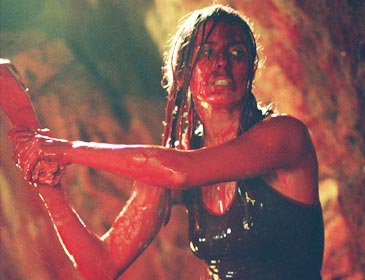
One of the few recent horror films that evokes some genuine fear, The Descent follows the women’s plunge into the darkest, most savage parts of the human soul, and confronts them with monsters both external and internal. The lighting, sound, and production design convincingly elicit the claustrophobic look and feel of a lost cave system. The lighting scheme allows the mind to imagine terror lurking just beyond the reach of luminosity and is used expertly to conceal and, at the appropriate time, suddenly reveal. The visual subtext of the film is of descent, terror, and rebirth, with a main character shown bursting through blood and slime into a frightening new version of the world. The convincing creature design and jolting editing add to the film’s gut-level impact.

If anything mars the film, it is the consistent visual references to other horror films, from Jaws and Carrie to Dario Argento’s Phenomena and Inferno, and the over-reliance on cheap shock cuts (though admittedly the riff on Martin Sheen from the climax of Apocalypse Now is arguably appropriate given the thematic similarity).

The Descent is plenty creepy and scary on its own, and when it stands alone without genre reference, it is an excellent horror thriller and, if nothing else, pegs Marshall as a filmmaker to watch.

---
Written and Directed by Neil Marshall

Starring:
Shauna Macdonald....Sarah
Natalie Mendoza....Juno
Alex Reid....Beth
Saskia Mulder....Rebecca
MyAnna Buring....Sam
Nora-Jane Noone....Holly

Aug 14, 2006

A Trifecta of Fantastic Films and Cameron’s Return

One of the best films of 2006 so far,V for Vendetta, had a fantastic setting--a future Britain ruled by an imaginary government of theocratic fascists--and the cinematic year looks to be seen out by three more film fantasies that also promise to be among the cream of 2006.

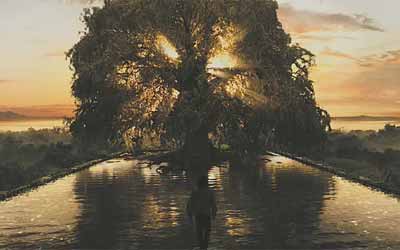
Darren Aronofsky’s The Fountain tells the story of the search for eternal life across three segments of time--the 18th century, the present day, and the far future. Hugh Jackman and Rachael Weisz star in this reportedly visually and intellectually dazzling film that was shot on a comparatively small budget, around $35 million. This will likely be a plus as large budgets for fantastic films often give birth to over-inflated movie grab bags stuffed to bursting with little regard for narrative clarity, invention, or subtlety (example: the moderately entertaining but hollow and overdone Pirates of the Caribbean: Dead Man’s Chest). The trailer is visually arresting and promises a serious dramatic film, hardly in line with Hollywood’s unspoken rule that all science fiction and fantasy movies must be action films.
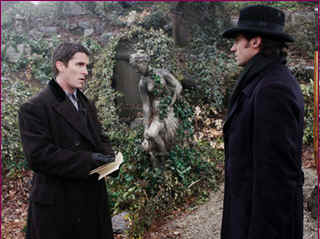
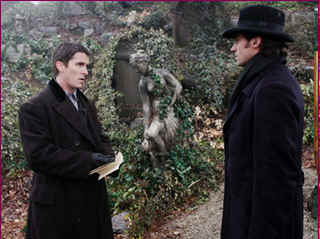
The Prestige reunites the director and main stars of the stylish and engrossing Batman Begins. Filmmaker Christopher Nolan directs Christian Bale and Michael Caine, along with Hugh Jackman (obviously choosing projects wisely these days) and Scarlett Johansen in a tale about a rivalry between two magicians in 19th century England. With Memento and Insomnia also under his belt, Nolan is a smart director with the visual flair of a David Lean, albeit seen through a darker lens. The Prestige promises to be a brooding, memorable story with excellent lead performances.

And lastly, there is Guillermo Del Toro’s Pan’s Labyrinth, a dark fantasy of a little girl’s imaginary world of strange creatures and places that begins to intrude upon the real world, a highly-anticipated film about which I have written before. Del Toro continues to grow as a craftsman and an artist who operates almost entirely within the horror/fantasy genre and, if there’s any sense of cosmic justice, he will make his long-gestating adaptation of H.P. Lovecraft’s enduring short novel of frozen, otherworldly terror, At the Mountains of Madness.

All three films are guided by directors who have shown themselves to be visionaries with a masterful grasp of visual cinema and, equally as important, an understanding of story, character, and subtext. Aronofsky, Nolan, and Del Toro are exactly the guiding lights that sf/fantasy cinema needs. They are capable of style and narrative and depth; their films are about something.

After years of largely hollow flash and spectacle, it is about time that sf/fantasy cinema received a boost or even a revolution that moves the genre beyond mega-budgeted popcorn fodder back into the realm of ideas that illuminate the human condition and stories that truly engage.

Perhaps this triple-blast of smart, imaginative fantasy will do the trick, especially if one of the films can accomplish the near-impossible and overcome the Academy Awards’ traditional snub of genre cinema.

And let’s not forget that, after a multi-year absence from narrative film, one of the great sf filmmakers is returning. James Cameron has announced that he is back in the game with two typically insanely ambitious sf film trilogies in various stages of planning: Avatar and Battle Angel. For all their flaws, Cameron’s films show an innate sense of efficient characterization, narrative pacing, and thematic subtext. The writing, direction, and editing of Terminator 2: Judgement Day are models for how to do an action film right, with a sense of story pacing, using peaks and valleys to give the audience time to breath, rather than a wearying all out assault on the senses.

Cameron really understands how to direct and edit action sequences. Unlike a Michael Bay film (I hate to always pick in him, but it’s so much fun, and he’s one of the worst offenders of the Moulinex Processor school of cutting), the editing is fast but not hyperactive, providing a rhythm and a sense of spatial geography so we know who is doing what to whom and the consequences of each move within a scene. He also knows when to use long shots to provide clarity, and does not chop up action into dozens of close-ups that flash by at seizure-inducing speeds. And in his chase sequences, the camera is in constant motion and not nailed to the floor as vehicles speed by, a pet peeve of mine.

Though Cameron is far from an artsy, philosophical director (he deals in spectacle and broad-brush themes), his films do have subtext. T2 and The Abyss both dealt with the innate human tendency to destroy and the potential dangers of unfettered technology. Titanic, Cameron’s biggest hit, warned about the hubris of thinking our solipsistic technological superiority imbrues us with the ability to conquer all the forces the world can throw at us. It also, of course, worked at a personal level, regarding breaking through social prisons of convention to pursue what and who we truly love. These are big, somewhat simplistic themes, but their mere presence in huge action spectaculars are enough to make Cameron’s films more interesting than the lion’s share of this type of movie.
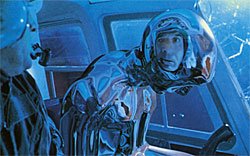
Cameron also pushes the envelope in terms of movie technology. The water tentacle in The Abyss and the T-1000 from T2 were pioneering uses of computer graphics imagery, or CGI, now so prevalent (some may argue overused) in the film industry. It remains to be seen how he will apply new technology in his upcoming films, but the prospects of new cinematic tools in the hands of a filmmaker that respects narrative is enticing.

Let us hope that the somewhat stagnant state of sf/fantasy filmmaking receives a shot in the arm from the likes of Aronofsky, Nolan, Del Toro, and Cameron. I think the genre is in desperate need of a revolution.
Jul 20, 2006

"Pan's Labyrinth"

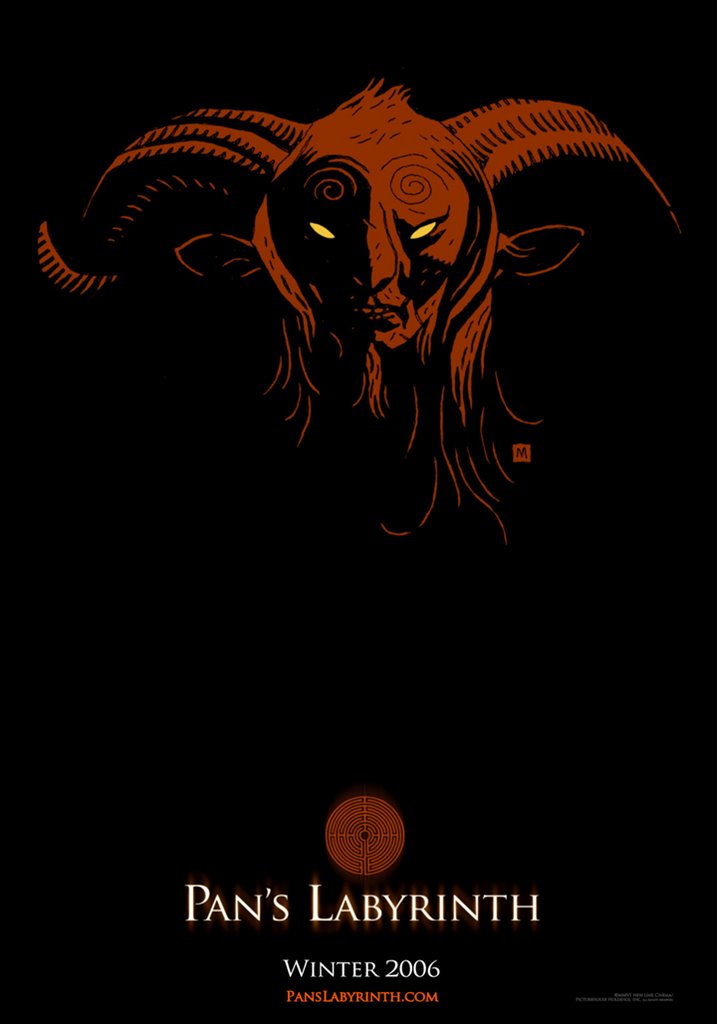
Check out this poster of Guillermo Del Toro's Pan's Labyrinth.


Sharp, stylish, memorable. Everything that Photoshopped studio movie posters are not. Comic book artist Mike Mignola drew the poster, he of Hellboy fame, which Del Toro adapted into an excellent feature film.

Pan's Labyrinth is apparently a horror/fantasy about a little girl who creates an imaginary world of fantastical creatures. I'm guessing that the imaginary world turns out to be not so imaginary. The setting for the film is intriguing: rural Spain in 1944. Early word on the film is that it's bold and imaginative. Some have called it a 'masterpiece.'

It looks to be close in tone and mood to Del Toro's great ghost story The Devil's Backbone which, if you haven't seen it, is a must-see. Moody, atmospheric, occasionally very scary, yet with a fully realized dramatic story and characters, The Devil's Backbone is one of the best supernatural-themed films for a long time.

Pan's Labyrinth has just jumped to near the top of my must-see list for 2006. However, we have a long wait; the release date is December 29.

Jul 19, 2006

My Favourite Movie (as of this moment)

Let me state this right off the top. When picking my favourite movie, I hereby divulge myself of the need to choose a film that is “artistically important.” I could, you know, choose an Ingmar Bergman film (I love Wild Strawberries), or another Classic of World Cinema. I shed the requirement to select something that is necessarily “serious.” Yes, I love Apocalypse Now, The Godfather, Gallipoli, The Third Man, and reams of other serious dramatic films. I will choose based completely on my personal love of cinema and on turning points.

Let me explain. In screenplays, turning points are when something happens in a film that spins it in a completely different direction. Louise Sawyer (Susan Sarandon) shooting and killing the cowboy dude who tried to rape her friend, thereby changing them into fugitives from the law, is an example of a turning point from Thelma and Louise. Life has turning points, too. And if you spend an inordinate amount of time watching and appreciating movies, your cinematic life also has turning points.

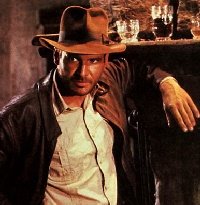
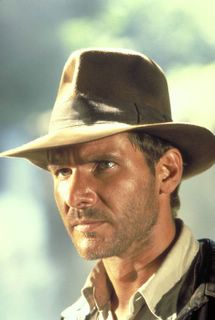
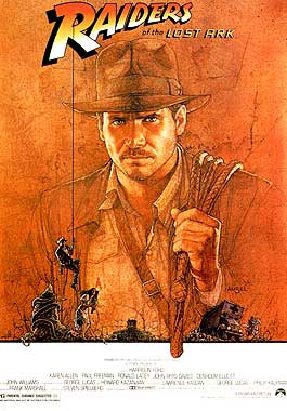
One of my key cinematic turning points was the joyful, exuberant, wonderfully exciting adventure film Raiders of the Lost Ark (1981). It’s only a small exaggeration to say that I walked into this film liking movies, and walked out LOVING them. As such, it is arguably the most important cinematic turning point for me, and so I have chosen it as my favourite film.

In the tradition of the Bond movies, Raiders begins with a short “mini-movie” that has little direct relevance to the rest of the plot. In this beautifully constructed sequence, we are introduced to Indiana Jones (Harrison Ford), a resourceful, globetrotting archaeologist who is in search of a legendary golden idol in the dark jungles of South America. In another Bond parallel, his introduction is like the first appearance of 007 in Dr. No. At first we see only glimpses of the character. A silhouette here, a fedora there, flitting through the shadows. He looks at a worn map. Behind his back, one of his guides slowly draws his gun. The metallic crack as the hammer is cocked causes a slight inclination of his head. Then, with blinding speed, a whip is snapped out, and the gun is wrenched from the villain’s hand. Indy finally steps into the light. It is the first time in the film that he cheats death, but definitely not the last. For the next two hours, the audience is taken on an adrenaline ride from America to Nepal to Egypt in pursuit of a lost holy relic called the Ark of the Covenant, which Hitler’s Nazi army would dearly like to get first.

The first collaboration between George Lucas and Steven Spielberg, Raiders of the Lost Ark is a milestone in the development of the action-adventure genre, and one of the few films that gets the difficult chemistry of the genre right. Action films are like the formula for an explosive. Too much oomph and the mixture explodes in your face; too little and it fizzles. Armageddon was like having someone fire an Uzi next to your face for two and a half hours; Tomb Raider was sleep-inducing. But when its mixture is correctly balanced, an action adventure burns at just the right pitch. Raiders of the Lost Ark gets it gloriously right.

Lawrence Kasdan’s screenplay (from a story by George Lucas and Philip Kaufman) towers above most in this genre. There are several set-pieces: the hunt for the golden idol and the escape from South America; the fight with the Nazis in Nepal; the street fight in Cairo; the discovery of the Ark; the amazing truck chase; and the phantasmagorical final opening of the Ark. These are imaginative and exciting sequences, based in spirit on the cliffhanging serials from the ’30s and ’40s. But the film does more than jump from action to action. It connects the action sequences with a good story and interesting characters. When there’s no action, we’re not snoozing in our seats; we are engrossed in the search for the ancient relic, and are enjoying the characters that are expertly brought to life.

This was Harrison Ford’s first major leading role, and he is magnetic. He creates a terrific hero, with a laconic Bogart-like presence, and a dash of human weakness. He hates snakes, and often has no set plan in mind, sometimes flying by the seat of his pants. One of the most memorable exchanges (paraphrased):

INDY: “Get me some transport to England. Boat, plane, anything…I’m going after that truck.”
SALLAH: “How?”
INDY: “I don’t know. I’m making this up as I go.”

Cinematic rollercoaster rides are common these days, so it’s easy to underestimate the impact of Raiders of the Lost Ark, which was one of the first. Up to that point in time, I watched a movie like this: dull scene starts the film; action scene; dull scene (time to review the action scenes in my head so I can remember the highlights); another dull scene; wake up for an action scene; and so on. Raiders was the first time that I was so engrossed in absolutely every frame that I had no time to review the highlights in my mind. The whole film was highlights.

I left the theatre pumped up with excitement. I just had to tell someone about this film. My friends and I babbled endlessly about it on the bus ride back. At the end of the day, we were reluctant to leave the experience behind us. I remember that during the opening sequence of the film, when Indiana Jones dodged the spiked gate that was triggered by passing through a shaft of light, my friend turned to me and whispered excitedly “This is an amazing film!” He was right. And it still is.