Nov 1, 2006

Dark Water

The supernatural drama Dark Water is, from one angle, a refreshing return to a ghost story with a human story at the centre, reminiscent of classics like Robert Wise’s The Haunting and Jack Clayton’s The Innocents. However, the supernatural elements don’t entirely gel, surprise, or scare as they should, and so Dark Water stays frustratingly out of reach of excellence.

Built on credible performances and characters, the film is really about a single woman struggling to survive, hang on to her child, and love her daughter in a way that she herself was never loved. Recent divorcee Dahlia (Jennifer Connelly) finds an apartment for herself and daughter Cecilia (Ariel Gade) in an old, foreboding building complex on Roosevelt Island in NYC. Desperate to prove her worth as a mother and provider so she can maintain custody of Cecilia, she takes a job that is beneath her talents as a copyeditor and quickly signs the papers for the dingy but affordably-priced apartment. In Polanski-esqe fashion, the building boasts a cast of vaguely threatening characters: specious building manager Mr. Murray (John C. Reilly); monosyllabic, icy caretaker Veeck (Pete Postlethwaite); and two sexually-menacing youths. Joining these troubling forces circling Dahlia is her ex-husband Kyle (Dougray Scott), who threatens to tear Cecilia away from her, and her persistent memories of abandonment and callousness by her mother.

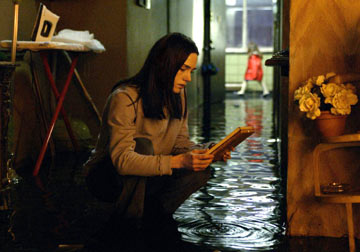
In true haunted-house genre fashion, odd events begin to happen. There are sounds of a small child running around in the empty apartment above. The elevator has a mind of its own and seemingly wants to take Dahlia to the tenth floor, where the abandoned apartment resides. Water begins leaking through the ceiling of the apartment, and the apartment above begins to flood with dark water. And Cecilia acquires an imaginary friend, one that doesn’t like being ignored.

A subtle underlying tension results from this set-up. Dahlia, financially struggling, emotionally damaged and in the midst of a custody battle, must appear entirely capable of raising her daughter. Kyle and his lawyer would seize on any hint of instability or hysteria, and so when the unexplained events begin to affect Dahlia, the stakes for her are raised considerably and the underlying suspense of the story ratchets up. Further beneath this in the narrative are the parallel threads of two individuals lacking and yearning for a motherly bond – one from beyond the grave.
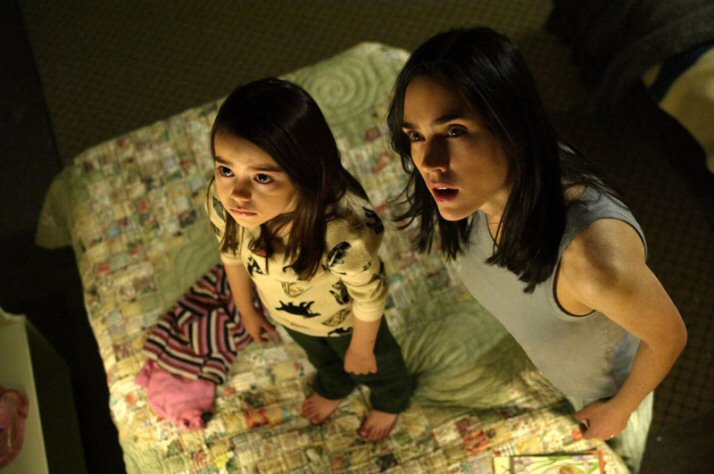
The emotional depth of Dark Water raise it far above conventional horror films, but unfortunately the ghost story within the piece doesn’t ultimately deliver. The solution to the mystery at the heart of the haunting is far too obvious and is delivered too quickly towards the end of the film. This is one film that deserves to be expanded with more ghostly build up, though the coda to the story is both creepy and moving. Director Walter Salles invests the drama with conviction, and the film is beautifully photographed, but he mishandles the supernatural aspects. In the end, Dark Water just isn’t scary enough and is too thinly plotted, which is unfortunate because, given the obvious intelligence of the film, some genuine chills and a meatier plot would have pushed it into classic territory.

As it is, Dark Water is worth watching for its characters and performances, and is a rare example of an intelligent film of the supernatural.

---
Directed by Walter Salles

Written by Rafael Yglesias, based on the novel by Kôji Suzuki and the screenplay by Hideo Nakata and Takashige Ichise

Starring:
Jennifer Connelly....Dahlia
John C. Reilly....Mr. Murray
Tim Roth....Jeff Platzer
Dougray Scott....Kyle
Pete Postlethwaite....Veeck
Camryn Manheim....Teacher
Ariel Gade....Cecilia

Oct 23, 2006

The Prestige

The co-writer/director and two of the cast members of Batman Begins reunite for The Prestige, filling the gap before production begins on The Dark Knight with a darkly lyrical tale of an obsessive psychological clash between two rival magicians in 19th century London.

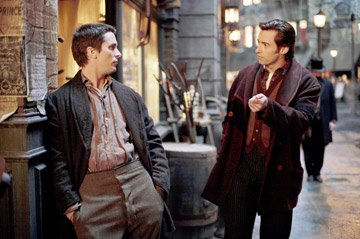
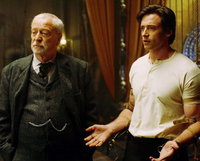
Rupert Angier (Hugh Jackman) and Alfred Borden (Christian Bale) begin the story as assistants to a run-of-the-mill magician. They come under the tutelage of a designer of magic tricks, Cutter (wonderfully played by Michael Caine). Cutter is like a 19th century Q, designing the complex mechanistic gadgets that produce the illusion of magic. The working-class Borden and the classy Angier fall out over a stage accident, and begin the rivalry that will dominate their lives. The story unfolds in an almost epistolary fashion, through two layers of flashback from the journals of the two magicians. Two quests dominate their obsession: the search for revenge, and the pursuit of the perfect magic trick.

Director Christopher Nolan has once again assembled a top-notch cast. Jackman applies his considerable charisma, yet shades it with some ambiguity, while Bale takes his psychological intensity and humanizes it. The result is that there is no clear-cut white hat/black hat split between protagonist and antagonist; each have admirable and deplorable qualities and both allow themselves to be drawn into a wasteful battle of wills. Michael Caine completes the main trifecta of characters with another turn as an older, wiser tutor and plays it so well that the repetition is forgiven. A rich roster of supporting performances, including a hard-to-recognize David Bowie, lend interest and dramatic weight, with Andy Serkis for once not acting in a motion-capture suit.

Between this film and Batman Begins, Nolan obviously has a fondness for a sepia-brown colour palette and uses it to great visual effect in the London scenes. Most scenes are darkly lit, reflecting a time when the night was only partially penetrated by gaslight, while several sequences set in a snowy town in America have an almost ethereal beauty. Cinematographer Wally Pfister has worked with Christopher Nolan on all of his films since Memento, and the result is a unique visual signature that rivals the look of Ridley Scott’s films, with whom Nolan shares the ability to create a believable, memorable cinematic world.

A marvel of production design, the sets of The Prestige are immensely textured and detailed. Look closely in the frame of any shot, and there’s some small detail to absorb, whether it’s a piece of magical machinery in a magician’s workshop or a pillar in a grimy street covered top to bottom with period handbills. The various magical gadgets of wood and steel and spring, whether strapped to the magician’s back or concealed as part of the stage, lend baroque but convincing detail. They almost look like some genuine relic you would see presented in a glass case at a museum. Some of the fantastical machines, especially those constructed by Nikola Tesla (David Bowie), are reminiscent of the spark-plasma lab equipment featured in the old Universal Frankenstein movies, a comparison that is cemented with the final shot of the film, which also recalls the Hammer Films’ Frankenstein movies, in particular a striking visual parallel to Terence Fisher’s The Revenge of Frankenstein (1958).

The meticulous design conjures a tangible sense of place and time that few period dramas achieve and mixes it up with an old-school mad scientist vibe that embodies the film’s distinction between a magician (illusionist) and a wizard (capable of genuine magic). In this vein, The Prestige also juxtaposes magic produced by apparent supernatural means and that resulting from science, and posits a world poised on the brink of rapid and staggering technological change that still has a thirst for magic.

Like the great magic tricks that are the subject matter of its plot, The Prestige is gloriously entertaining while the mechanics of a dexterous cinematic machine tick quietly away beneath the surface to produce some surprising narrative sleight of hand. The film ends in a plot reveal that turns out to have been carefully laid down, by dropping hints and clues along the way, with no cheating. So if a viewer figures it all out they have had to pay attention and use their minds to do so, and if not, they do not feel cheated. The Prestige may lack true substance, but it is a skillfully crafted and undeniably entertaining construction.

---
Directed by Christopher Nolan
Written by Jonathan Nolan and Christopher Nolan, from the novel by Christopher Priest

Starring:
Hugh Jackman....Rupert Angier
Christian Bale....Alfred Borden
Michael Caine....Cutter
Piper Perabo....Julia McCullough
Rebecca Hall....Sarah
Scarlett Johansson....Olivia Wenscombe
Samantha Mahurin....Jess
David Bowie....Nikola Tesla
Andy Serkis....Alley

Oct 16, 2006

THE DEPARTED

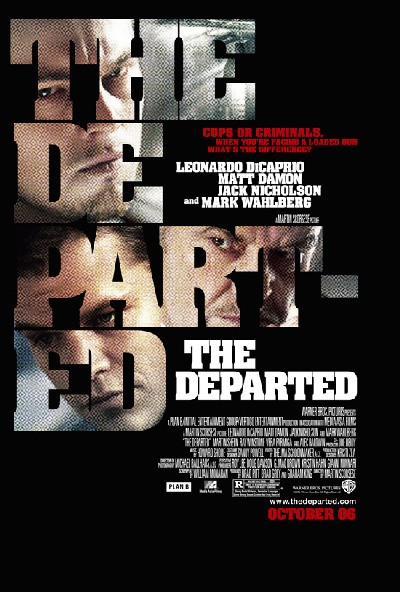
Martin Scorsese, arguably the greatest living American film director, returns to the crime drama genre with The Departed, a compelling, funny, and suspenseful thriller that is easily one of the best films of 2006.

Adapted from the Hong Kong crime thriller Infernal Affairs, the film explores fractured psyches and divided loyalties through two protagonists: Billy Costigan (Leonardo DiCaprio), a cop deep undercover in the crew of sadistic crime lord Frank Costello (Jack Nicholson), and Colin Sullivan (Matt Damon), Costello’s protégé and his mole in the Boston PD. Both gradually become aware of each other’s presence, and the film kicks into high tension-winding mode as they both try to track down and expose the other, leading to an ending of Shakespearean proportions.

A superb cast delivers several career-high performances. DiCaprio gives his best performance since The Basketball Diaries, projecting the desperation and existential loneliness of someone left without an identity. Damon manages to make his character sympathetic, no mean feat given that he’s aiding and abetting a psychopath. Jack Nicholson, said psychopath, pulls off a gestaltic piece of acting, building a smart, capricious, dexterous, and downright dangerous character out of many small moments that in other hands would shape a cliché. However, it is an almost iconic performance, and should net Nicholson another Oscar.

Scorsese has lost none of his ability as a filmmaker, brilliantly placing and moving the camera to capture and reflect interior and exterior action. There are no overly bombastic camera tricks here, though. In fact, one of the most effective scenes involves complete silence and two characters listening to each other on a cell phone connection. This moment is instructive of the power of great cinema – no digital effects, no fast and fancy editing, just a camera perfectly placed to capture two actors in a simple but intense moment that the writing has earned through smart, deliberate build-up. Another, briefer, moment that stayed with me was a shot of DiCaprio's face reflected in an ornament constructed of several hanging mirror shards, in a pellucid visual representation of a splintered psyche.

As with all of Scorsese’s films in this genre, there are several moments of explicit violence that are not discretely hidden off-screen. The Departed shows the dank, cagey backstreets of Boston in all their sick, jagged fury. Always a master of music choice, Scorsese chooses several classic songs and an effective score by Howard Shore to complement the cinematic action. One key song, the Stones’ Gimme Shelter, is repeated during the film, and is a cue that The Departed may at its heart be about fragmented individuals without a home in their inside and outside worlds.

William Monahan’s screenplay twists and turns, racking up the tension, and pausing here and there to spout some dialogue both quote-worthy (“I don't wanna be a product of my environment, I want my environment to be a product of me.”) and laugh-out-loud (politeness dictates that I don’t quote the funny but very profane moments).

The writing and direction build up the film to an almost operatic, epic drama. The Departed is sheer bloody poetry.

---
Directed by Martin Scorsese
Written by William Monahan, based on the screenplay Infernal Affairs by Siu Fai Mak and Felix Chong

Original Music by Howard Shore
Cinematography by Michael Ballhaus
Film Editing by Thelma Schoonmaker

Starring
Leonardo DiCaprio....Billy Costigan
Matt Damon....Colin Sullivan
Jack Nicholson....Frank Costello
Mark Wahlberg....Dignam
Martin Sheen....Oliver Queenan
Ray Winstone....Mr. French
Vera Farmiga....Madolyn
Anthony Anderson....Brown
Alec Baldwin....Ellerby

Oct 11, 2006

In a Nutshell: Elektra (2005)

I'm trying to find the right phrase, but why bother. To put it bluntly, Elektra (2005) is utter crap. Jennifer Garner stars as our martial-arts trained superheroine who kicks butt in hot outfits while an offscreen fan blows her hair seductively, as if Jenn was doing a commercial for Elektra Shampoo and Conditioner. Elektra, you may recall, was featured in Daredevil, and this film sets about the job of lowering the bar further than its predecessor with admirable dedication.

With the standard set very high for comic book adaptations by the superb Batman Begins, the simple-minded, nonsensical cotton candy of Elektra falls completely flat. When you roll your eyes at the very first line of the film--narrator Terrence Stamp somberly intones "There is an eternal battle between good and evil..."--you know you're in trouble.

An anti-teleological curry of recycled leftovers, this mediocre lump isn't even good for laughs. The plot makes little sense, and if you started to pick holes in the film, you'd be left with a few scraps of Swiss cheese. Here’s a few things I learned from Elektra:

1) A supernaturally-invulnerable muscle man can be killed by a falling tree.

2) Flying daggers can plow through hedges with no discernable loss of vector or momentum.

3) Assassins from the ‘Order of the Hand’ are in fact replicants that contain yellow powder. Or they are demons made from yellow smoke. Or something.

4) Being forced to tread water without using your hands as a child turns you into a hired killer with obsessive-compulsive disorder.

5) Yes, it is possible to make a comic-book film that makes X-Men: The Last Stand look like quality cinema.

To paraphrase Monty Python, this isn't a film for enjoying; it's a film for lying down and avoiding.